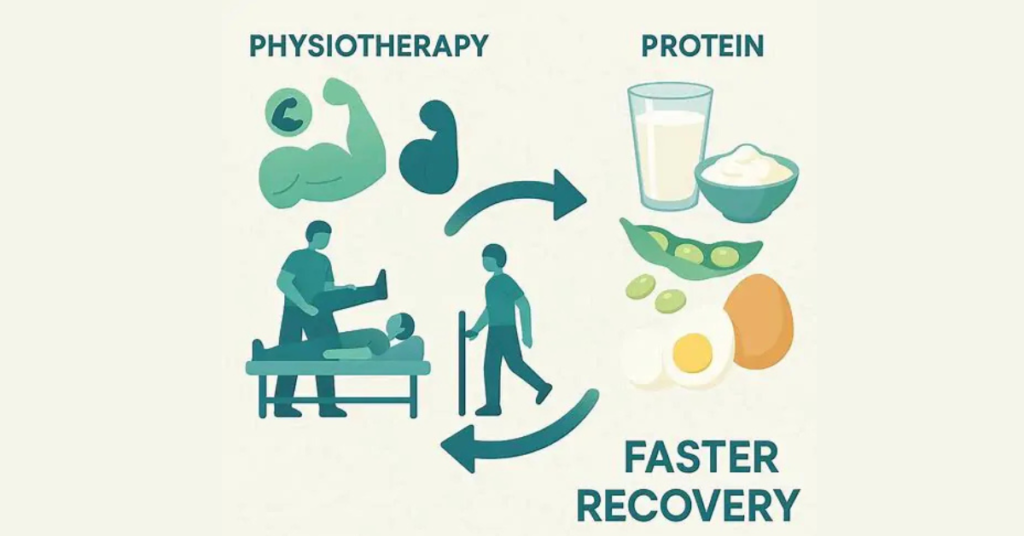
Knee osteoarthritis (OA) is a progressive degenerative condition that significantly impacts mobility, muscle strength, and quality of life. While cartilage degeneration defines the pathology, muscle weakness—particularly quadriceps weakness—is a major contributor to pain, instability, and functional decline.
Knee physiotherapy protocols remain the gold standard in conservative management. However, clinical outcomes can vary depending on muscle activation capacity, fatigue levels, and baseline muscle mass.
Recent research and performance-based models suggest that creatine supplementation may enhance clinical outcomes when integrated appropriately with structured knee physiotherapy protocols.
This article explores the physiological rationale, clinical applications, and when creatine alone—or in combination with protein—may produce optimal results.

Knee Osteoarthritis: Beyond Cartilage Degeneration
Knee OA is not solely a joint surface disorder. It is also a muscle performance problem.
Common muscular impairments include:
- Quadriceps inhibition due to pain
- Reduced voluntary activation
- Loss of muscle cross-sectional area
- Decreased neuromuscular efficiency
Quadriceps weakness increases tibiofemoral joint loading, contributing to:
- Persistent pain
- Difficulty with stairs
- Reduced walking endurance
- Slower response to knee physiotherapy
Thus, muscle restoration is central to improving clinical outcomes.
Why Clinical Progress in Knee Physiotherapy Sometimes Plateaus
Even well-designed physiotherapy protocols may show slower-than-expected progress due to:
1. Pain-Limited Intensity
Pain reduces effort, limiting effective strength loading.
2. Early Fatigue
Reduced metabolic efficiency causes rapid exhaustion.
3. Age-Related Muscle Loss
Many OA patients have baseline sarcopenia.
4. Suboptimal Intramuscular Energy Availability
Muscle contraction depends on rapid ATP regeneration.
This metabolic limitation creates an opportunity for targeted supplementation.
The Role of Creatine in Muscle Physiology
Creatine is stored in skeletal muscle as phosphocreatine. It plays a critical role in ATP regeneration during short, repeated muscular contractions.
During knee physiotherapy exercises such as:
- Quad sets
- Short arc knee extensions
- Long arc knee extensions
- Leg raises
- Hip strengthening drills
- Knee stabilization movements
Muscles require rapid ATP turnover.
Creatine supplementation increases phosphocreatine stores, leading to:
- Faster ATP regeneration
- Greater contraction efficiency
- Improved strength output
- Reduced perceived fatigue
When consistently combined with resistance-based knee physiotherapy, this can enhance measurable clinical outcomes.
Mechanisms Through Which Creatine Enhances Clinical Outcomes
Enhanced Strength Gains
Improved energy availability allows higher-quality repetitions.
Improved Training Tolerance
Patients may complete more sets or tolerate progressive resistance.
Reduced Fatigue During Sessions
Improves adherence and engagement.
Support for Lean Muscle Mass
Creatine supports muscle hypertrophy when paired with resistance loading.
Improved Neuromuscular Performance
May enhance motor unit recruitment efficiency.
When Creatine Alone Is Appropriate
Creatine supplementation alone may be sufficient in:
- Early-stage knee osteoarthritis
- Mild to moderate quadriceps weakness
- Patients with adequate dietary protein intake
- Individuals experiencing early fatigue during physiotherapy
- Non-surgical knee OA cases focused on performance enhancement
In these cases, creatine primarily enhances muscle energy capacity.
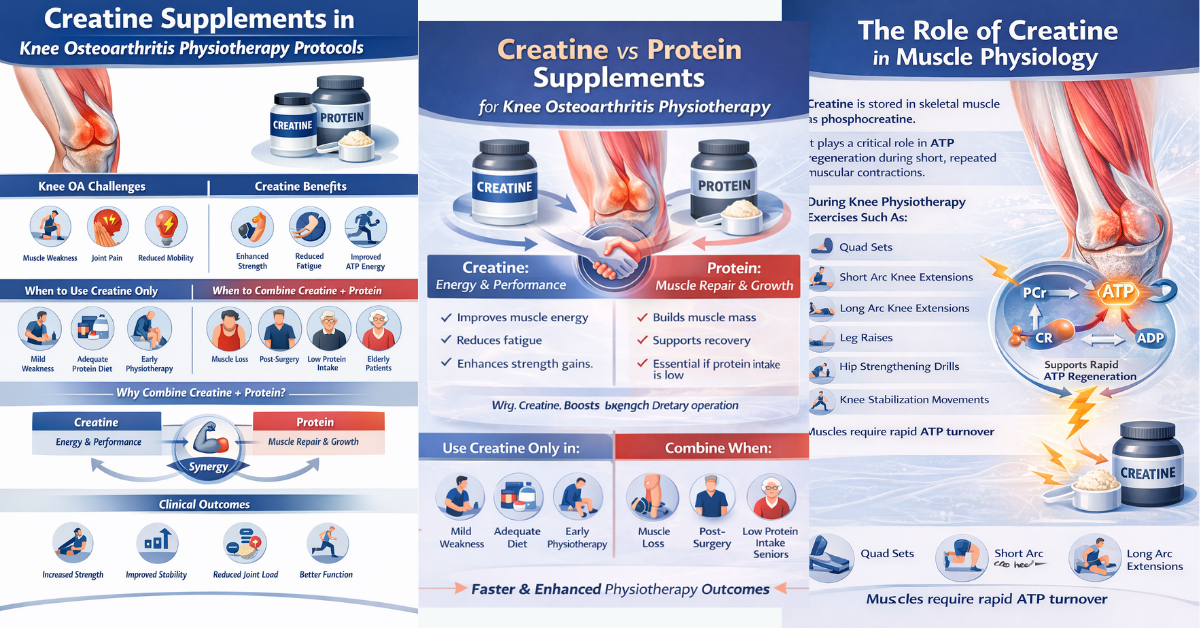
Creatine vs Protein Supplements – When to Combine and Who Benefits Most
Although both creatine and protein support muscle function, they serve different physiological roles.
Creatine: Energy System Support
- Enhances ATP regeneration
- Improves short-duration strength output
- Reduces fatigue during training
- Supports neuromuscular efficiency
Best suited for:
- Patients with fatigue-limited physiotherapy performance
- Individuals with adequate protein intake
- Those seeking improved session quality
Protein: Structural Muscle Support
- Provides amino acids for muscle repair
- Supports muscle protein synthesis
- Essential for rebuilding lost muscle tissue
- Critical in sarcopenic individuals
Best suited for:
- Patients with visible muscle loss
- Older adults with low dietary protein intake
- Post-surgical knee cases
- Individuals with undernutrition
When to Combine Creatine and Protein
The combination becomes particularly valuable when both muscle energy and muscle rebuilding are required.
Ideal Candidates for Combination Therapy:
- Moderate to Severe Muscle Atrophy
- Post-Surgical Knee Patients
- Elderly Individuals With Sarcopenia
- Patients With Poor Nutritional Intake
- Individuals Requiring Accelerated Strength Gains
Why the Combination Works
- Protein supplies the building blocks (amino acids).
- Creatine enhances the performance capacity to use those building blocks effectively.
Protein supports muscle structure.
Creatine supports muscle function.
Together, they create a synergistic effect in knee physiotherapy protocols.
Expected Improvements in Clinical Outcomes
When integrated properly into structured knee physiotherapy programs, creatine (with or without protein) may contribute to:
- Increased quadriceps strength
- Improved knee stabilization
- Reduced joint loading
- Greater walking tolerance
- Improved stair performance
- Enhanced overall functional capacity
These improvements can translate into measurable clinical progress.
Safety Considerations
Creatine is one of the most researched supplements globally.
General guidelines:
- Maintenance dose: 3–5 grams daily
- Adequate hydration
- Avoid in severe kidney disease
- Use under professional guidance
Protein intake should be individualized based on body weight and muscle status.
Integrating Supplementation Into Knee Physiotherapy Protocols
A structured approach may include:
- Progressive quadriceps strengthening
- Hip abductor strengthening
- Knee stabilization drills
- Functional loading progression
- Nutritional screening
- Creatine supplementation when energy support is needed
- Protein optimization when rebuilding muscle mass
Knee physiotherapy remains the primary driver of adaptation. Supplementation enhances the internal physiological environment that supports those adaptations.
Conclusion
Knee osteoarthritis management requires more than symptom control. Restoring muscle strength and improving functional performance are central to achieving meaningful clinical outcomes.
Creatine supplementation may enhance knee physiotherapy outcomes by improving muscle energy availability, reducing fatigue, and supporting strength development.
Creatine alone is appropriate for patients needing performance enhancement without significant muscle loss. However, in cases involving sarcopenia, post-surgical muscle rebuilding, or undernutrition, combining creatine with protein may accelerate and improve clinical outcomes.
Strategic integration of nutrition into knee physiotherapy protocols represents an evidence-informed, performance-based model of musculoskeletal care.