(Prepared under expert guidance of Dr. Ramana, Endocrinologist, Bangalore | with Dr. Prasanna Kumar, Orthopedician, Madurai & Dr. Yalini, Menopause Specialist, Madurai)
Introduction: Why Vitamin D3 Remains the Most Undercorrected Deficiency in India
Vitamin D3 deficiency continues to be one of the most widespread yet poorly corrected nutritional deficiencies in India.
Despite millions of prescriptions for:
- Weekly 60,000 IU sachets
- Standard OTC tablets
- Gummies and chewables
Many patients still fail to achieve adequate 25‑hydroxy Vitamin D serum titres.
As Dr. Ramana (Endocrinologist, Bangalore) highlights:
“Vitamin D deficiency is not about availability of supplements—it is about absorption, metabolism, and sustained correction.”
This is where daily liposomal Vitamin D3, such as Precimax Liposomal Vitamin D3 Capsules, is emerging as a modern clinical solution.

Why Secondary Care Providers Must Prioritize Daily Vitamin D3 Correction
This blog is especially relevant for:
✅ Physiotherapists
✅ Functional medicine specialists
✅ Dietitians
✅ General practitioners
✅ Orthopedic rehabilitation providers
Because Vitamin D is central to:
- Bone recovery
- Muscle strength
- Chronic inflammation control
- Immunity balance
- Mood and cognition
Dr. Prasanna Kumar (Orthopedician, Madurai) notes:
“In osteoarthritis and osteoporosis care, inadequate vitamin D correction is one of the most common reasons for poor recovery.”
Why Patients Fail to Reach Adequate Vitamin D Levels Even After Supplements
Many Indians remain “low” despite supplementation due to:
- Poor intestinal fat absorption
- Obesity (vitamin D sequestration in fat tissue)
- Diabetes and metabolic inflammation
- Menopause and accelerated bone loss
- Liver or kidney conversion impairment
- Irregular weekly bolus adherence
Dr. Yalini (Menopause Specialist, Madurai) explains:
“In menopause, vitamin D deficiency becomes deeper and harder to correct because bone turnover and inflammation accelerate.”
Why Daily Liposomal Vitamin D3 is Becoming the Clinical Standard
Weekly bolus dosing (60,000 IU) may not provide steady physiological correction.
Daily liposomal dosing offers:
✅ Better absorption
✅ Sustained serum rise
✅ Lower dose, high efficiency
✅ Reduced variability
Dr. Ramana adds:
“Daily physiological dosing produces more stable titres compared to intermittent bolus therapy.”
Precimax Liposomal D3 can be used:
- Alongside weekly 60,000 IU protocols
- Or alone as daily correction support
- Or even twice daily in resistant deficiency under supervision
Clinical Conditions Where Adequate Vitamin D Serum Levels Matter Most
Vitamin D is not just for bones—it regulates immunity, inflammation, mood, metabolism, and healing.
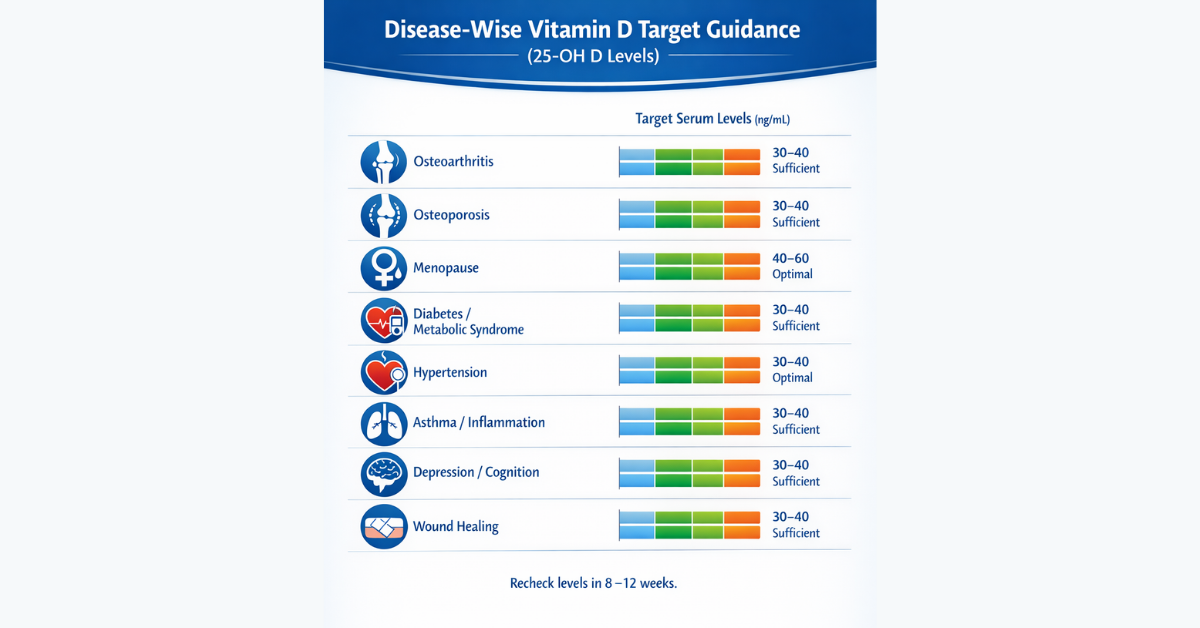
Target Vitamin D Levels in Common Conditions
| Condition | Desired 25(OH)D Level | Typical Before | After Daily Liposomal D3 (8–12 weeks)* |
|---|---|---|---|
| Osteoarthritis | 40–60 ng/mL | 15–25 | 40–55 |
| Osteoporosis | 50–70 ng/mL | <20 | 45–65 |
| Menopause bone loss | 50–70 ng/mL | 18–28 | 45–60 |
| Diabetes & metabolic syndrome | 40–60 ng/mL | 15–30 | 40–55 |
| Hypertension | 35–55 ng/mL | 20–30 | 38–55 |
| Asthma/inflammation | 40–60 ng/mL | <25 | 40–50 |
| Depression & cognition | 40–70 ng/mL | 10–25 | 45–60 |
| Wound healing support | 50–70 ng/mL | <20 | 50–65 |
Dr. Prasanna Kumar emphasizes:
“Vitamin D adequacy is foundational in orthopedic pain and bone degeneration management.”
Daily Dosing for Children and Seniors: Precimax 60’s Capsules Advantage
Daily low-dose delivery is especially valuable for:
- Seniors with poor gut absorption
- Children requiring physiological correction
- Patients intolerant to high bolus doses
Precimax Liposomal Vitamin D3 capsules provide:
✅ Small dose, high absorption
✅ Easier daily compliance
✅ Reduced risk of peaks and crashes
Dr. Ramana states:
“In geriatrics, daily dosing is safer, more predictable, and better tolerated than large bolus spikes.”
Supporting Nutrients: Magnesium + K2‑7 for Superior Outcomes
Vitamin D3 does not work in isolation.
Magnesium is essential for:
- Vitamin D activation
- Muscle relaxation
- Sleep quality
K2‑7 ensures:
- Calcium goes into bones
- Prevents vascular calcium deposition
That’s why co‑administration improves outcomes.
Dr. Yalini notes:
“Menopausal bone recovery requires vitamin D, magnesium, and K2 synergy—not isolated supplementation.”
Understanding Deficiency Clinically + Testing Protocol
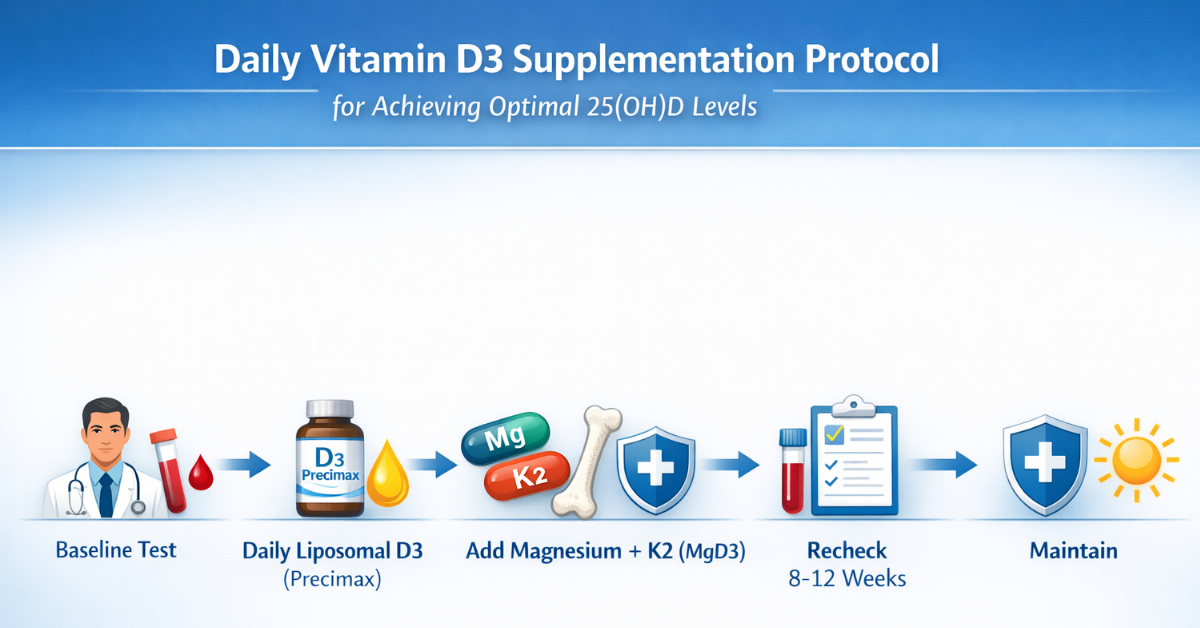
Baseline Tests Before Starting
- Serum 25(OH) Vitamin D
- Calcium
- Phosphorus
- Magnesium
- PTH (in severe deficiency)
Monitoring During Supplementation
- Repeat 25(OH)D after 8–12 weeks
- Renal function if high-dose therapy
- Symptoms improvement tracking
Dr. Ramana advises:
“Correcting deficiency should always be biomarker-guided, not guesswork.”
Population Likely to Stay Deficient Even After Supplements
High-risk groups include:
- Obese individuals
- Diabetics
- Post-menopausal women
- Chronic steroid users
- Malabsorption disorders
- Elderly with low conversion capacity
Solution:
✅ Liposomal absorption + daily sustained dosing
✅ MgD3 synergy
✅ Regular titre monitoring
Vitamin D3 Formulations: Advantages & Limitations
Formulation Comparison
| Formulation | Advantage | Disadvantage |
|---|---|---|
| Weekly 60,000 IU sachets | Fast correction | Peaks/crashes, poor compliance |
| Standard 2000 IU tablets | Cheap | Variable absorption |
| OTC gummies/chewables | Convenient | Low clinical potency |
| Liposomal Vitamin D3 Capsules (Precimax) | High absorption, sustained | Premium clinical formulation |
| Liposomal MgD3 Combo | Superior bone-muscle synergy | Best under guided protocols |
Which Combination is Best for Which Patient?
Clinical Use Cases
| Combination | Best For |
|---|---|
| Liposomal D3 alone | Routine deficiency correction |
| Liposomal MgD3 (D3+Mg+K2) | Osteoporosis, menopause, muscle pain |
| Weekly 60K + Daily Liposomal D3 | Resistant deficiency |
| Liposomal D3 + Curcumin | Inflammation + arthritis |
| Liposomal D3 + Glutathione | Immune + oxidative disorders |
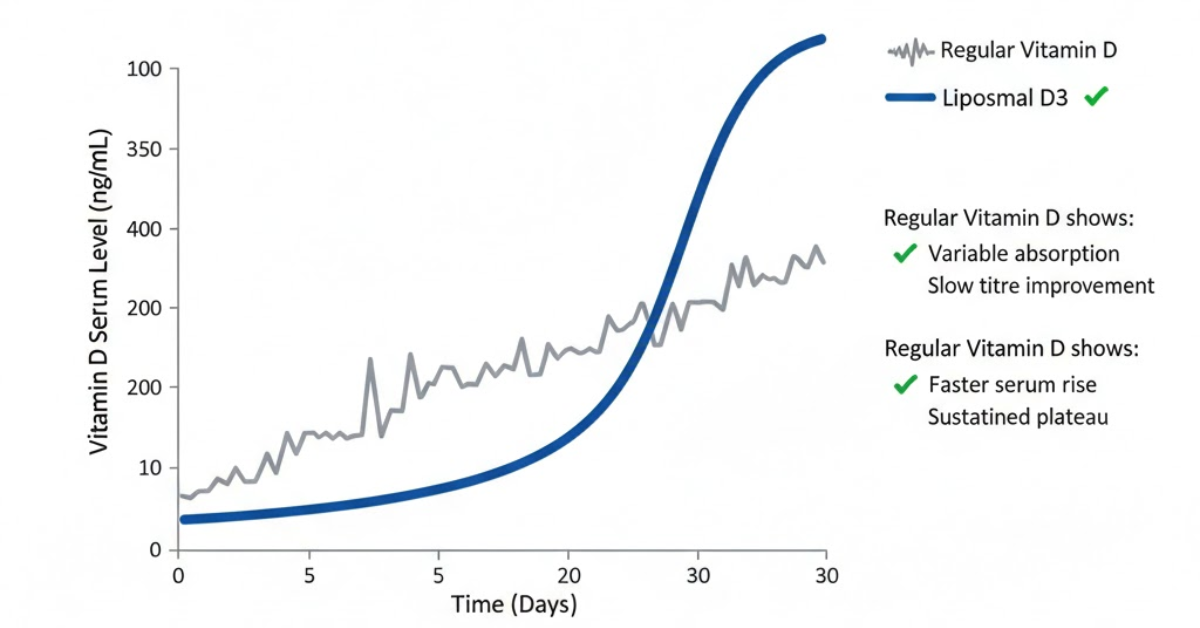
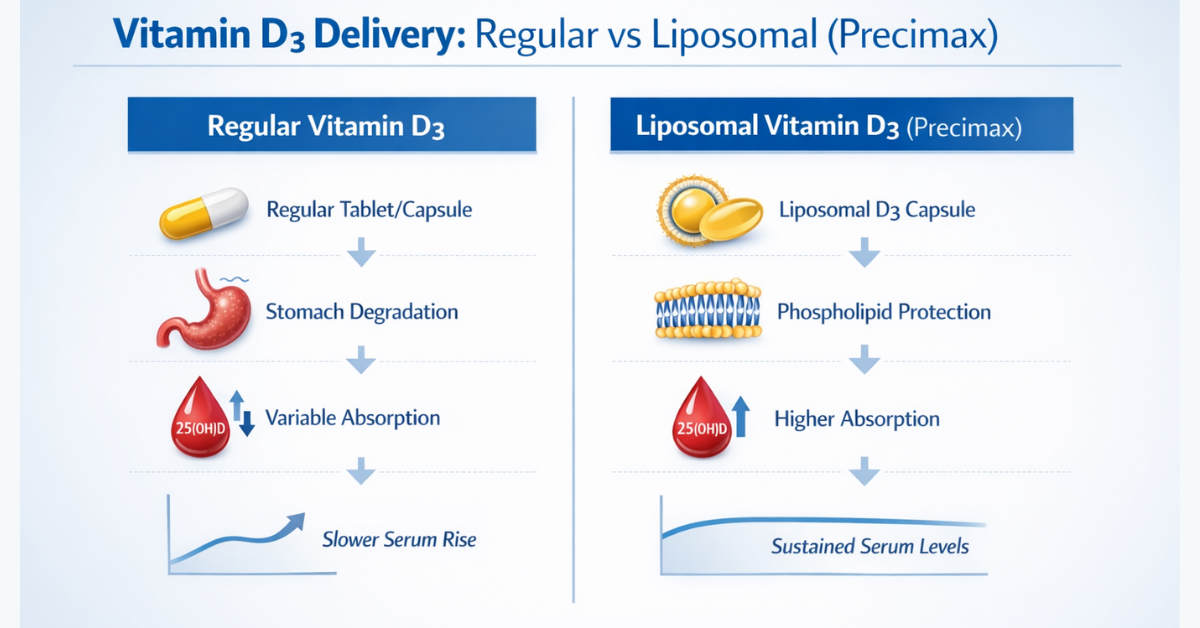
The graph compares the bioavailability of two Vitamin D delivery methods over 30 days:
Regular Vitamin D: Shows variable absorption and a slow titre improvement, resulting in inconsistent and low serum levels.
Liposomal D3: Demonstrates a faster serum rise and a sustained plateau, indicating much higher uptake and more efficient nutrient delivery.