
Why the Same Yoga Practice Produces Different Results in Different People
Every International Yoga Day, millions of people recommit themselves to a healthier lifestyle through yoga.
Some practice yoga to reduce stress.
Some hope to lose weight.
Others want stronger bones, healthier joints, better flexibility, improved digestion, or support for healthy ageing.
Yet a fascinating observation often emerges:
Two people may attend the same yoga class, perform the same asanas, and practice with equal dedication—but experience very different outcomes.
One feels energized, flexible, and stronger.

The other continues to struggle with fatigue, stiffness, slow recovery, or limited progress.
Why?
Because yoga is only one part of the equation.
The body’s ability to respond to yoga depends on many factors, including nutrition, recovery, age, muscle mass, vitamin status, gut health, and overall metabolic health.
Simply put:
Yoga provides the stimulus. Nutrition helps the body respond to that stimulus.
This International Yoga Day, instead of asking:
“What is the best yoga pose?”
Ask:
“Am I giving my body the nutritional support it needs to benefit fully from yoga?”
The answer depends largely on your goal.
Which Type of Yoga Practitioner Are You?
Different goals require different nutritional priorities.
Let’s explore some common yoga goals and the nutrients that may help support them.
I Practice Yoga for Joint Health and Mobility
Common Reasons
- Knee stiffness
- Early osteoarthritis
- Back discomfort
- Reduced flexibility
- Healthy ageing
Many people turn to yoga because they want to move comfortably and maintain independence as they age.
While yoga improves mobility and flexibility, muscles, joints, and connective tissues also require nutritional support.
Nutritional Priorities
✓ High-quality Protein
✓ Vitamin D3
✓ Magnesium
✓ Bioavailable Curcumin
Why These Matter
Protein supports muscles that protect joints.
Vitamin D3 supports musculoskeletal function.
Magnesium contributes to muscle performance and movement.
Curcumin supports a healthy inflammatory response and recovery.
What You May Notice
- Better movement confidence
- Improved exercise consistency
- Enhanced recovery
- Support for active lifestyles
I Practice Yoga for Bone Health
Common Reasons
- Osteopenia
- Osteoporosis concerns
- Menopause
- Fall prevention
Yoga can improve balance, posture, coordination, and confidence.
However, bone health depends on much more than movement alone.
Nutritional Priorities
✓ Vitamin D3
✓ Vitamin K2-7
✓ Magnesium
✓ Protein
Why These Matter
Vitamin D supports calcium metabolism.
Vitamin K2-7 helps guide calcium utilization.
Magnesium supports bone and muscle health.
Protein contributes to musculoskeletal integrity.
What You May Notice
- Better balance
- Improved confidence during movement
- Support for healthy ageing
I Practice Yoga for Weight Loss
Common Reasons
- Weight management
- Metabolic wellness
- Lifestyle improvement
Many people lose weight while practicing yoga.
The challenge is maintaining muscle mass during the process.
Nutritional Priorities
✓ Protein
✓ Dietary Fiber
✓ Probiotics
✓ Essential Amino Acids
Why These Matter
Protein helps preserve lean muscle.
Fiber supports satiety.
Probiotics support gut health.
Amino acids support recovery.
What You May Notice
- Better dietary compliance
- Reduced hunger
- Better body composition
- Improved exercise consistency
I Practice Dynamic Yoga and Surya Namaskar
Common Reasons
- Fitness
- Stamina
- Performance
- Daily conditioning
Dynamic yoga styles place greater demands on muscles and energy systems.
Nutritional Priorities
✓ Protein
✓ Essential Amino Acids
✓ Magnesium
✓ Creatine
Why These Matter
Muscles require amino acids to recover.
Creatine supports cellular energy production.
Magnesium supports energy metabolism and muscle function.
What You May Notice
- Better recovery
- Reduced fatigue
- Improved exercise tolerance
- Greater consistency
I Practice Yoga for Heart Health
Common Reasons
- Stress management
- Healthy ageing
- Cardiovascular wellness
Yoga has long been recognized for supporting relaxation and mental wellbeing.
Nutritional Priorities
✓ CoQ10
✓ Magnesium
✓ Resveratrol
✓ Omega-3 Fatty Acids
Why These Matter
These nutrients support cardiovascular wellness, cellular energy production, and healthy ageing.
What You May Notice
- Improved wellbeing
- Better energy support
- Enhanced long-term wellness
I Practice Yoga for Gut Health and Digestive Wellness
Common Reasons
- Bloating
- Digestive discomfort
- Gut wellness
- Overall wellbeing
The connection between the gut and overall health is now widely recognized.
Nutritional Priorities
✓ Multi-Strain Probiotics
✓ Prebiotics
✓ Curcumin
✓ Protein
Why These Matter
A healthy gut supports nutrient utilization, immune function, and overall wellbeing.
What You May Notice
- Better digestive comfort
- Improved gut health
- Enhanced wellbeing
I Practice Yoga for Healthy Ageing
Common Reasons
- Remaining active after 40
- Maintaining mobility
- Preserving independence
- Staying strong with age
Perhaps the most important reason people practice yoga is to age well.
Nutritional Priorities
✓ Protein
✓ Vitamin D3
✓ Magnesium
✓ Vitamin B12
Why These Matter
These nutrients support muscle function, mobility, recovery, energy production, and healthy ageing.
What You May Notice
- Better energy
- Improved resilience
- Better movement quality
- Greater confidence during daily activities
 \
\
Quick Reference Table
Your Yoga Goal | Nutritional Priorities |
Joint Health | Protein + Vitamin D3 + Magnesium + Curcumin |
Bone Health | Vitamin D3 + K2-7 + Magnesium + Protein |
Weight Loss | Protein + Fiber + Probiotics |
Dynamic Yoga | Protein + EAA + Magnesium + Creatine |
Heart Health | CoQ10 + Magnesium + Resveratrol + Omega-3 |
Gut Health | Probiotics + Prebiotics + Curcumin |
Healthy Ageing | Protein + Vitamin D3 + Magnesium + B12 |
Quick Self-Assessment
Do any of these sound familiar?
□ I practice yoga but still feel tired.
□ Recovery takes longer than expected.
□ My joints feel stiff despite regular exercise.
□ I struggle to meet my protein needs.
□ I have been told my Vitamin D is low.
□ I frequently experience muscle cramps.
□ Digestive issues affect my wellbeing.
□ I am over 40 and concerned about healthy ageing.
If you checked multiple boxes, your nutritional status may deserve as much attention as your yoga routine.

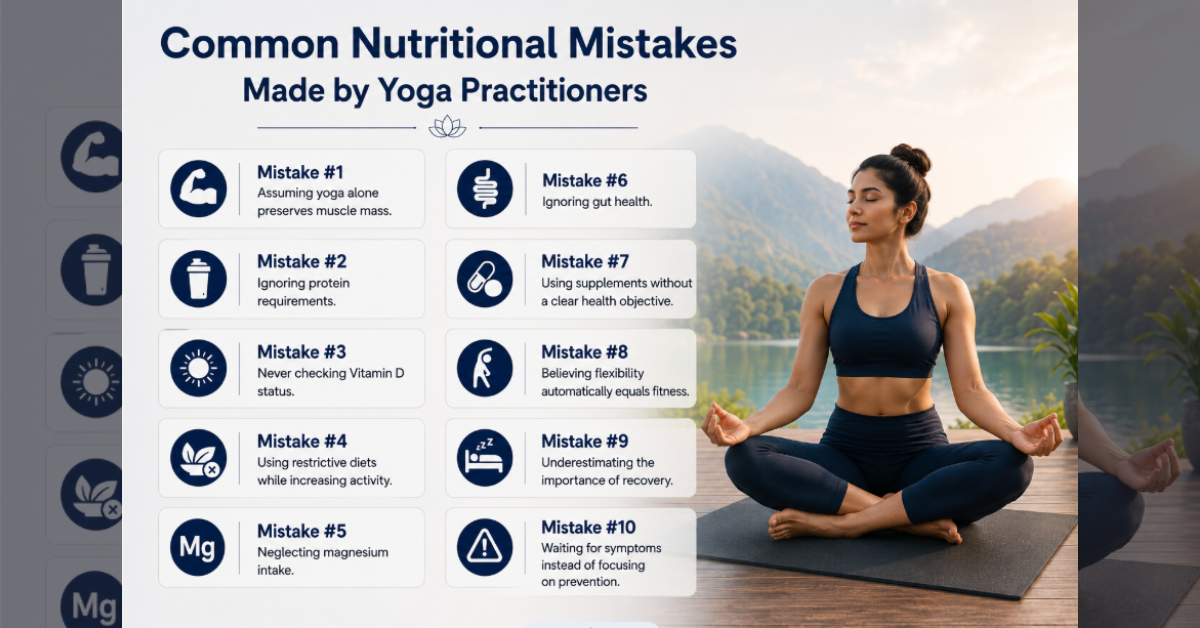
Common Nutritional Mistakes Made by Yoga Practitioners
Mistake #1
Assuming yoga alone preserves muscle mass.
Mistake #2
Ignoring protein requirements.
Mistake #3
Never checking Vitamin D status.
Mistake #4
Using restrictive diets while increasing activity.
Mistake #5
Neglecting magnesium intake.
Mistake #6
Ignoring gut health.
Mistake #7
Using supplements without a clear health objective.
Mistake #8
Believing flexibility automatically equals fitness.
Mistake #9
Underestimating the importance of recovery.
Mistake #10
Waiting for symptoms instead of focusing on prevention.
Final Thoughts
Yoga remains one of the most powerful tools for improving physical and mental wellbeing.
However, yoga is not one-size-fits-all.
The same practice can serve different purposes for different people—joint health, weight management, bone health, digestive wellness, cardiovascular support, recovery, or healthy ageing.
Understanding your goal is the first step.
Matching your nutritional strategy to that goal is the next.
This International Yoga Day, think beyond the pose.
Think about how nutrition, recovery, and healthy lifestyle practices work together to help your body derive the greatest benefit from yoga.
Because the best outcomes are often achieved when movement and nutrition work as partners, not competitors.