Introduction
Creatine Supplement is one of the most researched and clinically validated performance-enhancing nutrients in the world. Yet, in India, supplement awareness is low, consumption is rare, and misconceptions are widespread — especially among parents of young athletes and general population. This is unfortunate, because creatine is not just a “bodybuilding supplement”; it is a cellular energy molecule required for muscle contraction, brain function, recovery, metabolism, and growth — crucial for children, teens, adults and seniors.
A recent scientific review published in 2025 titled “Creatine supplementation is safe, beneficial throughout the lifespan, and should not be restricted” strongly emphasizes that creatine is safe across all age groups, including adolescents, and can contribute significantly to muscle development, cognitive function, metabolic health and physical performance.

This publication challenges outdated thinking and highlights why creatine should not be limited but instead considered an essential nutritional support, especially in regions like India where dietary creatine intake is extremely low due to predominant vegetarian/flexitarian dietary patterns.
When we combine global evidence with India’s nutritional reality — the story becomes even more compelling.
Why India Needs Creatine Supplement Awareness More Than Ever
India ranks high in:
- Vegetarian or plant-dominant dietary population
- Protein deficiency prevalence
- Low muscle mass vs higher fat mass ratios
- Early onset fatigue & poor stamina in school children & young athletes
- Increasing metabolic syndrome rates (even in teens)
- Elderly frailty, sarcopenia & weak functional strength
Creatine is found naturally only in meat, fish & animal tissue. Vegetarians get close to zero dietary creatine and have lower muscle creatine stores on average. This isn’t ideology — this is biochemistry.
Who does this affect most?
- Children & adolescents in growth phase
- Student-athletes unable to complete matches
- Kids with low appetite for protein foods
- Vegetarians purely on dal-rice-roti meal patterns
- Overweight children with low stamina
- Adults with fatigue, low strength, poor metabolism
- Sedentary office workers
- Elderly who lose muscle rapidly with age
Creatine Supplement isn’t a bodybuilder’s drug.
It’s an energy currency molecule essential to power the body.

What Does the 2025 Creatine supplement Safety Publication Tell Us?
The review summarizes decades of clinical findings and concludes:
- Creatine is safe across the lifespan from childhood to old age
- Long-term creatine supplementation shows no harmful renal/hepatic impact in healthy individuals
- Benefits extend beyond sport — into brain health, bone health, metabolism & recovery
- Creatine restriction for adolescents has no scientific basis and may disadvantage developing athletes
- Research shows positive associations between creatine and lean mass, cognitive function, growth & overall vitality
The authors emphasize expanding creatine accessibility rather than limiting it. This is directly relevant to India, where athletic talent is high — but nutritional support is low.
The Vegetarian Gap — Why Indian Kids Fall Behind in Strength & Muscle
Studies show that creatine stores are 20–30% lower in vegetarians due to absence of dietary sources. Lower muscle creatine levels lead to:
- Reduced phosphocreatine availability
- Weaker ATP recycling during high-intensity movement
- Faster fatigue & slower recovery
- Lower muscle power & sprint capacity
- Reduced muscle protein synthesis signaling
For badminton, cricket, kabaddi, football, athletics, swimming — creatine is fuel for explosive repeat effort.
- A child may start a match strongly, but fatigue sets in early.
- A teenager may train hard, but progress is slow.
- A young athlete may eat healthy, yet lacks power.
Creatine solves the missing link between diet & performance.
Creatine Supplement Benefits Proven Across Research
Supported by over 1,000+ clinical papers, creatine demonstrates:
- Strength & Power ↑
- Muscle growth ↑
- Endurance ↑
- Recovery acceleration ↑
- Brain function & memory ↑
- Glucose uptake & metabolic efficiency ↑
- Reduced inflammation & fatigue ↓
- Better lean mass-to-fat ratio
In the 2025 review, researchers highlighted creatine’s long-term safety and its role in energy metabolism, neuromuscular performance and exercise output.
Other notable findings from international literature:
- Useful in adolescent athletes to promote growth & performance
- Improves sprint, jump, racquet sport performance
- Helps clinical populations including elderly & recovering individuals
- Supports brain bioenergetics in students under learning load
- Can support metabolic health including glucose management
Creatine is one supplement backed so strongly that global sports nutritionists call it: “The safest and most evidence-based ergogenic aid in the world.”
But Why Aren’t Indians Using Creatine Supplement Enough?
Common reasons:
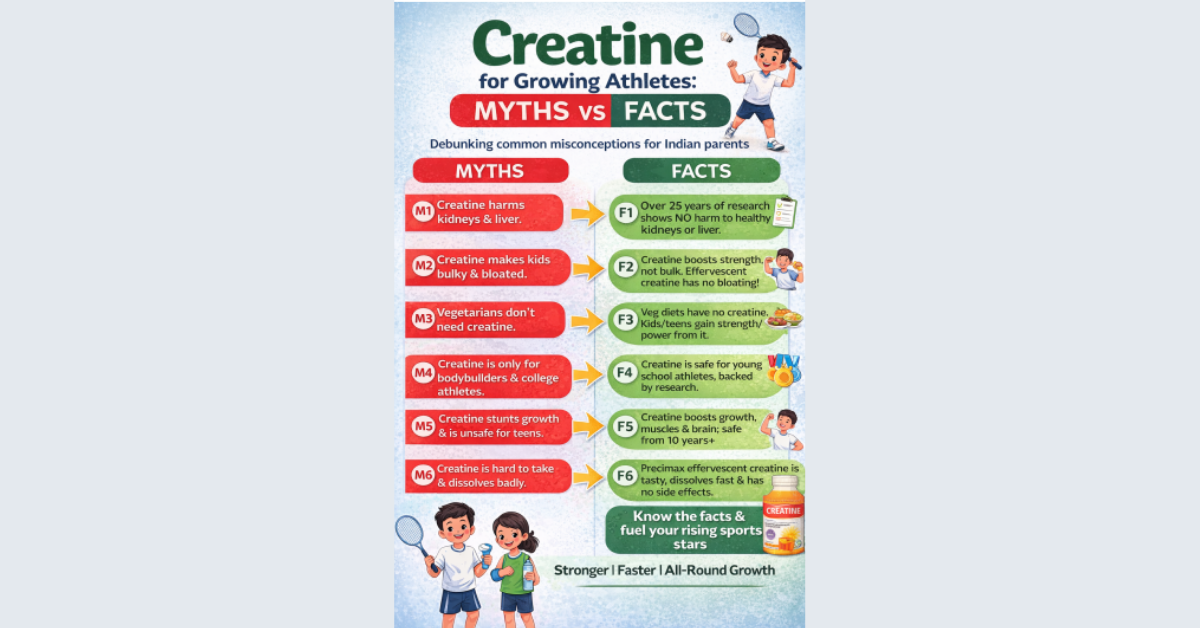
- Myths like it damages kidneys — scientifically untrue for healthy users
- Parents worry giving creatine to children — evidence supports safe use
- Taste & mixing issues with plain monohydrate
- “Powder feels heavy / bloating” — sometimes true with poor solubility
- Lack of awareness that vegetarians get zero creatine naturally
India doesn’t lack talent — it lacks nutritional literacy.
Creatine could accelerate performance, stamina & growth if introduced strategically with guidance.
How Much Creatine Supplement Is Needed?
- Daily requirement: ~3–5 g/day
- Non-vegetarians meet ~1g from food.
- Vegetarians meet close to 0 g.
Supplementation becomes almost essential for athletes, teens in growth, and adults with fatigue or high body fat.
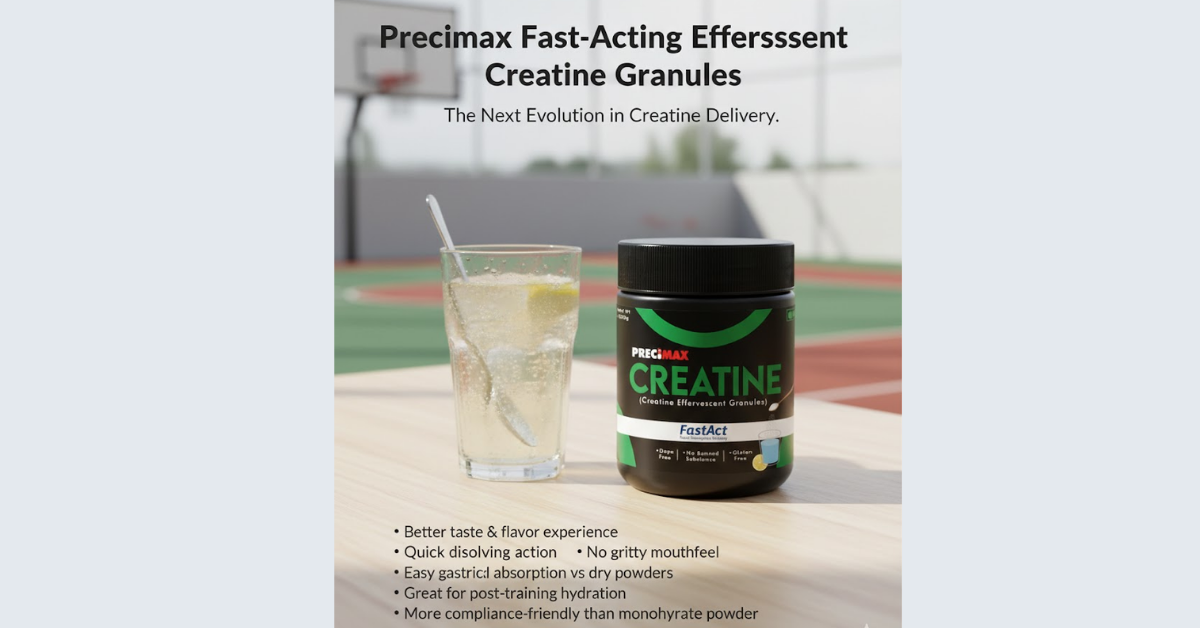
Precimax Fast-Acting Effervescent Creatine Supplement Granules — The Next Evolution in Creatine Delivery
Instead of raw micronized powder that must be dissolved & often tastes chalky, effervescent granules offer:
- Better taste & flavor experience
- Quick dissolving action
- No gritty mouthfeel
- Easy for kids, teens & seniors
- Fast gastric absorption vs dry powders
- Great for post-training hydration
- More compliance-friendly than monohydrate powder
This makes supplementation practical and sustainable, especially for young athletes like Nirav (example case) who require performance fueling but struggle with taste or powder mixing.
Precimax’s effervescent form can be taken:
Training days: Pre-workout (15–30 min before) or post-workout
Non-training days: Morning with water/juice
Simple. Palatable. Performance supporting.
Creatine must be consistent — not occasional.
A tasty format ensures consistency.
Creatine for The Indian Youth – A Mass Health Opportunity
Consider the potential impact if schools, academies & parents adopt creatine:
- Faster improvement in stamina
- Players finish matches strong
- Better lean mass → lower fat %
- Improved focus for studies
- Stronger bones & injury resilience
- Higher recovery, less fatigue
- Confidence & motivation increase
Creatine is not about making kids bulky —
it’s about helping them grow stronger, healthier, sharper.
For general population — creatine supports energy, strength, body composition, aging & metabolic health. A truly lifespan supplement, as the 2025 review emphasizes.
Frequently Asked Questions
- Is creatine safe for children/teen athletes?
Yes. Research strongly supports use in adolescents when supervised. - Will creatine damage the kidneys?
No evidence shows kidney harm in healthy individuals. Kidney concerns are myth-based. - Do vegetarians need creatine more?
Yes. Vegetarian diets have almost zero creatine → supplementation is highly beneficial. - Does creatine cause water retention/bloating?
Only mild intracellular hydration initially, which helps muscle performance. Effervescent forms reduce discomfort. - Can girls take creatine?
Absolutely — strength, stamina, cognitive & metabolic benefits apply equally. - Can creatine help in weight/fat management?
Yes — increases muscle mass → raises metabolism → improves body composition. - Should creatine be taken daily?
Yes. Consistency > dose spikes. - What’s the ideal dosage?
3–5g/day for most individuals. No need for loading phase in youth. - How soon are results seen?
Strength improvements in 2–4 weeks, body composition in 8–12 weeks. - Does creatine help cognitive function?
Yes — improves brain energy & memory especially in vegetarians. - Can elders take creatine?
Yes — supports muscle loss prevention, mobility, fatigue & brain function. - Is effervescent creatine better than regular powder?
Better taste, better solubility, higher compliance — excellent for beginners & teens. - Should creatine be taken pre or post workout?
Either works. Post-workout with carbs gives slight advantage. - Can creatine be taken without exercise?
Yes — still benefits muscles & brain, though exercise accelerates results. - How long can creatine be taken?
Indefinitely — long-term use is safe as per current evidence.
Take-Home Summary
Vegetarian-heavy Indian diets lack natural creatine →
Lower creatine stores →
Lower strength, stamina, muscle & metabolic efficiency.
The 2025 review confirms:
✔ Creatine is safe across lifespan
✔ Should NOT be restricted for youth
✔ Benefits muscle, metabolism & brain
✔ Ideal for vegetarians & athletes
To bridge the dietary gap, a palatable and user-friendly format matters.
This is where Precimax Fast-Acting Effervescent Creatine Granules elevate creatine adoption — removing taste barriers & improving compliance.
- India doesn’t lack athletes.
- India lacks creatine awareness.
- And awareness begins with blogs like this.
Recent 2025 clinical reviews confirm that creatine supplementation significantly enhances muscle recovery, brain health, and metabolic efficiency across all ages, while maintaining a rigorous safety profile for long-term use. This research highlights its critical role in energy resynthesis and neuroprotection, especially for growing athletes and those on plant-based diets.
👉 Click here to read the full 2025 publication
Related Blogs
Creatine Supplement Demystified: Science, Benefits, Limitations, and Why Absorption Matters
Creatine Supplement Forms Explained: Powders, Capsules, Chews, Effervescents — How to Choose the Right On
Creatine vs Protein vs Amino Acids: What to Take, When to Take Them, and Should You Combine Them?
Creatine Supplementation in Women: Current Evidence, Science, and Real‑World Benefits