Curcumin remains one of the most researched natural anti-inflammatory molecules in the world, with over 9,000 scientific publications supporting its role in pain reduction, immune modulation, metabolic control, gut health, neurological protection, and cancer research. Yet, despite such incredible potential, most people who consume turmeric or even regular curcumin supplements fail to experience meaningful clinical relief.
Why?
Because curcumin by itself is poorly absorbed. It is hydrophobic, unstable at intestinal pH, rapidly metabolized in the liver, and cleared out of systemic circulation within minutes. The result is paradoxical — a highly potent compound in theory, but poorly effective in practice when consumed as raw powder or even as standardized 95% curcumin extract.
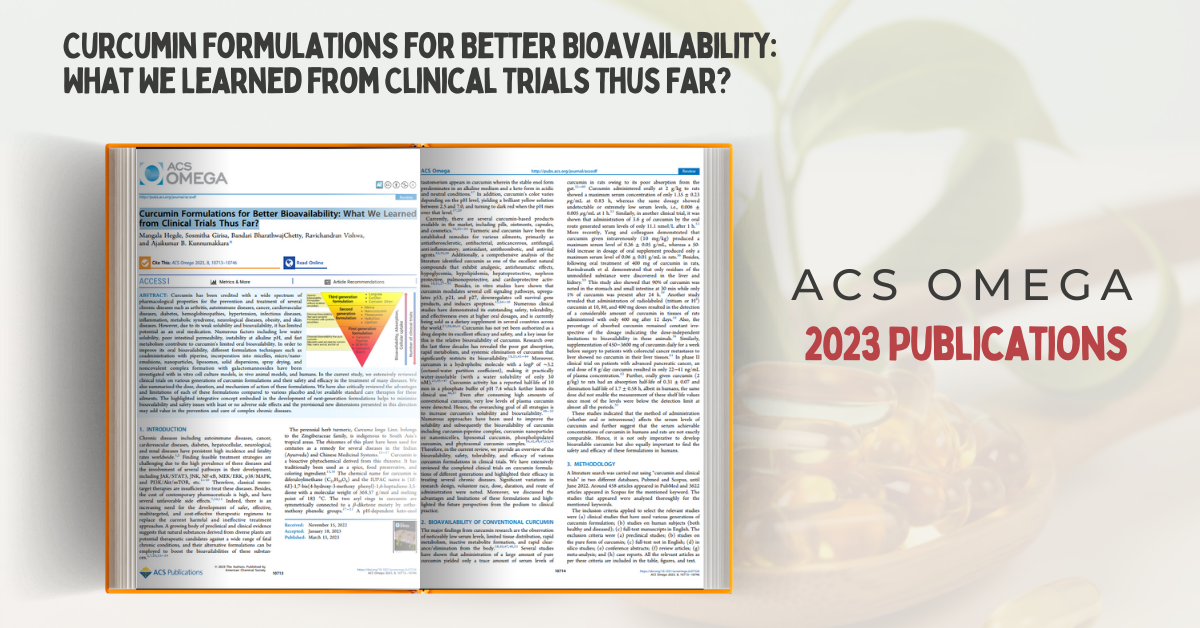
The 2023 Curcumin Bioavailability Comparative Publication establishes this gap clearly:
Even high doses of standard curcumin extract show extremely low plasma availability, making consistent therapeutic outcomes difficult and requiring large doses — which increases gastrointestinal side effects without proportional benefit This challenge triggered the evolution of newer curcumin technologies — from piperine-based enhancement to liposomal encapsulation to third-generation micellar and lyophilized systems designed to improve solubility, stability, bloodstream retention, and tissue penetration.
Among these next-generation formulations, Cucimax stands out as a novel integrative curcumin technology — combining micellar nano-encapsulation (particle size 100–100 nm) with lyophilization, delivering 52X higher bioavailability compared to standard curcumin, a 500 mg optimized payload per capsule, and a 3-year stability profile preserving all three major curcuminoids.
This blog breaks down why this innovation matters for doctors, patients, and nutraceutical developers — scientifically, clinically, and economically.
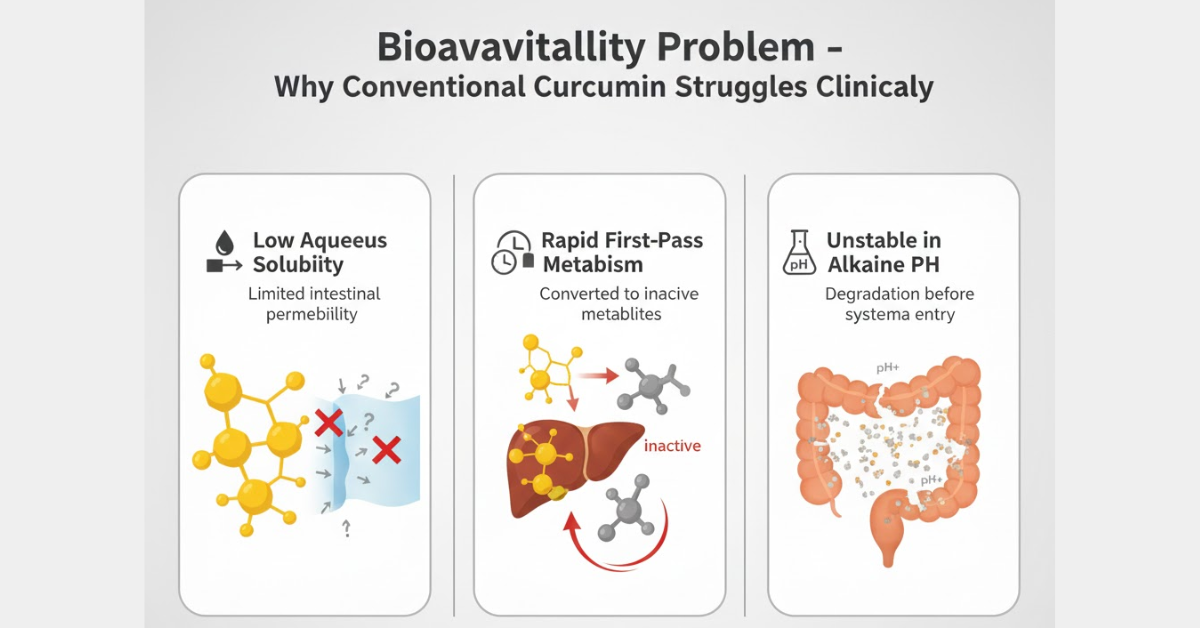
The Bioavailability Problem – Why Conventional Curcumin Struggles Clinically
Curcumin faces three major absorption barriers:
- Low aqueous solubility resulting in limited intestinal permeability
- Rapid first-pass metabolism converting curcumin to inactive metabolites
- Unstable in alkaline pH leading to degradation before systemic entry
According to the 2023 publication, standard curcumin (even 95% extract) demonstrates poor oral absorption, requiring gram-level doses to achieve measurable serum concentration.
This explains why a person may take turmeric for years yet see minimal improvement, or why 2g–4g of raw curcumin extract is often needed to show modest clinical benefit.
Even piperine-enhanced curcumin — widely marketed as the solution — has limitations:
- Piperine increases permeability by irritating intestinal mucosa
- Enhances absorption but not systemic stability
- Unsafe for long-term use in individuals on medications
Piperine boosts uptake only at the entry point, not throughout circulation.
This brings us to the need for true bioavailability technologies, not absorption gimmicks.
The Shift to Nano-Micellar and Liposomal Curcumin
The second wave of curcumin research focused on lipid carriers. Liposomal encapsulation was an improvement, increasing solubility and plasma retention. However, micellar technology emerged superior, mimicking the body’s natural fat-absorption system.
Micellar curcumin forms nano-sized droplets, dispersible in water, allowing:
- Better intestinal absorption
- Higher serum retention
- Enhanced cellular entry
- More predictable dose-response outcomes
Where raw curcumin floats and passes unabsorbed, micelles dissolve into intestinal micelle pools, enter lymphatic circulation, and maintain activity longer.
The 2023 comparison study reported a 40–60X increase in bioavailability for micellar and advanced nano-encapsulated forms. This aligns remarkably with Cucimax’s documented 52X improvement, validated through internal clinical experience.
Lyophilization – The Protection Layer Most Formulations Miss
Even advanced micellar forms face a challenge: curcumin’s natural sensitivity to light, heat, and oxidation.
This is where lyophilization becomes transformative.
Lyophilization is a cold-vacuum dehydration process that preserves curcuminoid structure at molecular level. In Cucimax, this method:
Retains 3 major curcuminoids
- Curcumin
- Demethoxycurcumin
- Bis-demethoxycurcumin
Prevents oxidation and potency loss
- Ensures sustained quality during storage
- Allows 3-year product stability
- Maintains therapeutic payload without degradation
This technological combination (micellar + lyophilized) ensures that the curcumin you swallow is the curcumin your cells actually receive.
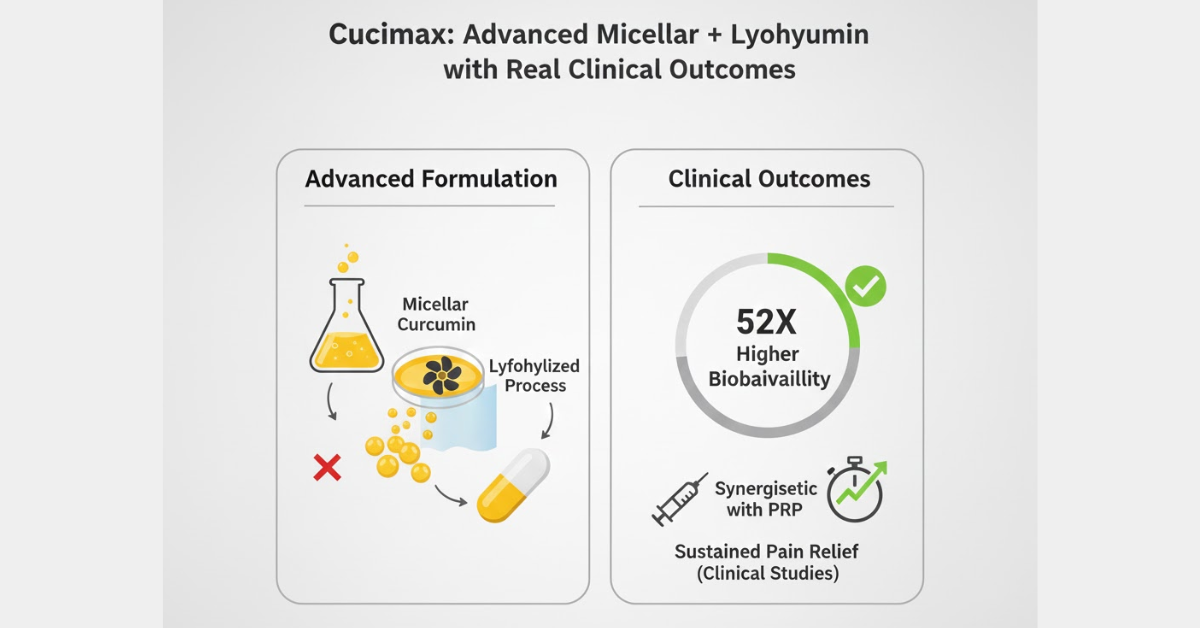
Cucimax: Advanced Micellar + Lyophilized Curcumin with Real Clinical Outcomes
- Curcuminoid concentration: 90% standardized extract
- Micelle particle size: 100–100 nm
- Bioavailability improvement: ~52X higher vs plain curcumin
- Dose: 500 mg per capsule
- Protocol: 2 capsules daily for 3 weeks, then 1 capsule maintenance
- Stability: 3 years without potency loss
Reported clinical benefits from real-world usage:
- Reduction in pain (measured using VAS score)
- Fasting glucose reduction 8–10% over 6–10 weeks
- Improved lipid profile
- Total cholesterol reduced with HDL increase
- Symptom relief in IBD/Inflammatory bowel conditions
Clinical Experience – What Doctors Have Observed with Cucimax
These practitioner insights demonstrate practical value beyond lab statistics.
Dr. Madhusudan
Pranava Holistic Wellness & Integrative Medicine, Bangalore
“We use Cucimax as our first-line anti-inflammatory support in joint pain and metabolic inflammatory conditions. Patients report noticeable pain reduction within 2–4 weeks, and those combining physiotherapy achieve faster recovery. The stability and tolerability are better than piperine-based curcumin, making compliance high.”
Dr. Vaman Rao
Omega Cancer Centre, Vijayawada
“In oncology supportive care, inflammation control is critical. We prefer Cucimax due to predictable absorption and minimal gastric irritation. Post-chemotherapy recovery markers show favorable improvement, especially appetite, bowel regularity, and energy. The lyophilized micellar format is a game changer.”
Dr. Ajay Ghosh
Metabolic Health Specialist, Hubli
“In diabetic and dyslipidemic patients, Cucimax has shown improvements in fasting glucose and HDL profile within 6–12 weeks. Many patients reduced analgesic dependency. The biggest benefit is consistent clinical response — something I rarely saw with raw curcumin.”
These real-world observations validate what science already suggests — bioavailable curcumin performs better, faster, and safer.
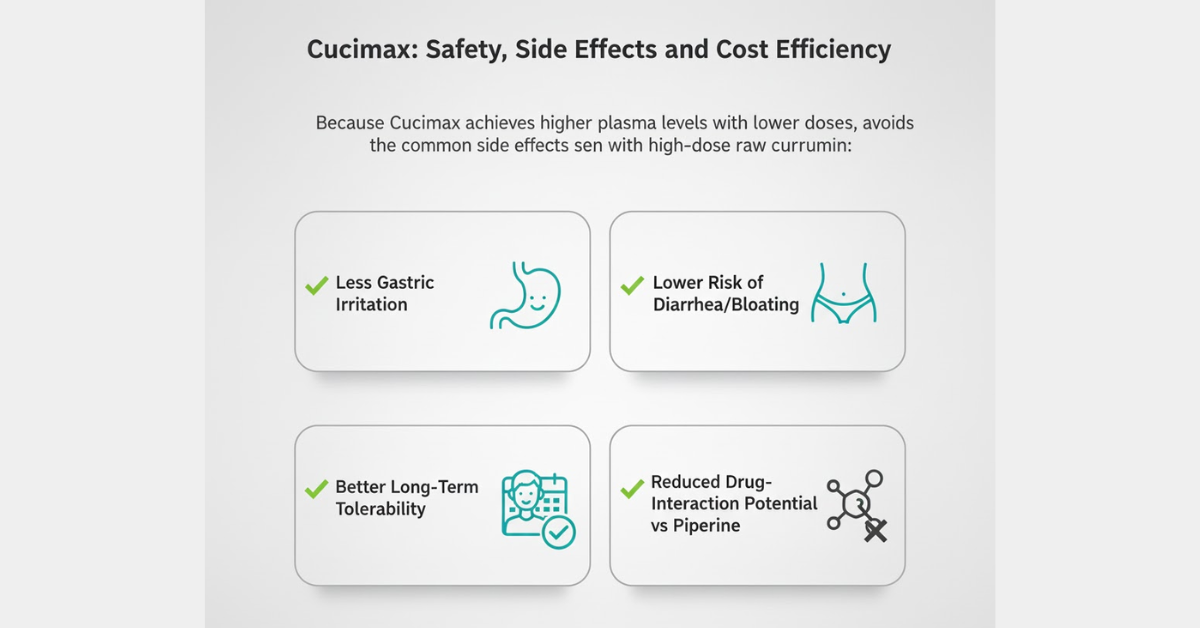
Safety, Side Effects, and Cost Efficiency
Because Cucimax achieves higher plasma levels with lower doses, it avoids the common side effects seen with high-dose raw curcumin:
- Less gastric irritation
- Lower risk of diarrhea/bloating
- Better long-term tolerability
- Reduced drug-interaction potential vs piperine
Cost efficiency becomes evident when comparing mg-to-mg benefit:
- Conventional curcumin requires grams to achieve effect
- Cucimax provides clinical benefit at 500–1000mg
- Therefore less dose = more effect = better value over time
3-year shelf stability further reduces wastage and maintains economic advantage for clinics and retail pharmacies.
Key Takeaways for Consumers & Clinicians
- All curcumins are NOT the same — bioavailability decides outcome
- Micellar/Liposomal formats outperform piperine-enhanced curcumin
- Lyophilization protects curcuminoids and ensures potency for 3 years
- Cucimax demonstrates 52X improved absorption & measurable results
- Clinical outcomes show pain reduction, metabolic improvement & gut benefits
- Lower dose but higher delivery means fewer side effects and better compliance
The future of curcumin is not in increasing dose — but improving delivery.
Frequently Asked Questions
- Why doesn’t regular curcumin work well?
Raw curcumin is poorly absorbed and rapidly metabolized, leading to weak plasma levels. - What makes micellar curcumin better?
Micelles increase water dispersion and intestinal absorption, improving systemic delivery. - How does lyophilization help?
It protects curcumin from oxidation and ensures stable potency for 3 years. - How is Cucimax different from standard curcumin?
It combines micellar nano-delivery with lyophilization, enhancing absorption by ~52X. - How much Cucimax should one take?
2 capsules daily for 3 weeks, followed by a 1-capsule maintenance plan. - Can it replace piperine-based curcumin?
It works without causing mucosal irritation seen with piperine. - Does curcumin help joint pain?
Yes, Cucimax users have reported VAS pain score reduction in clinical observation. - Can Cucimax help diabetics?
Studies show metabolic improvement; fasting glucose reduction 8–10% is reported. - Does it improve cholesterol?
Clinical cases reported lower total cholesterol and improved HDL. - Is Cucimax safe for long-term use?
Yes, due to low-dose high-delivery format. - Can it help in IBD or gut inflammation?
Yes, reduction in inflammatory bowel symptoms reported by users. - How fast do results appear?
2–6 weeks for pain & inflammation, 6–12 weeks for metabolic outcomes. - Does it cause acidity or gastric irritation?
Very minimal compared to raw curcumin or piperine formulations. - Why is 90% curcuminoid concentration important?
It ensures precise therapeutic payload of curcumin, demethoxy, and bisdemethoxy curcumins. - Is Cucimax more expensive?
Price per capsule is higher, but cost per clinical outcome is lower due to high absorption.
Conclusion
Curcumin is powerful — but only when delivered effectively.
Traditional forms struggle with bioavailability, leading to inconsistent outcomes and high-dose requirements. Piperine-enhanced forms improved absorption but introduced irritation and interaction concerns. The real breakthrough arrived with nano-micellar and liposomal technologies — delivering curcumin the way the human body can actually use it.
Cucimax represents the next evolution.
A micellar curcumin encapsulated in a lyophilized stabilized form, standardized at 90% curcuminoids, 52X more bioavailable, clinically shown to improve pain, fasting glucose, lipid balance, and gut inflammation, with minimal side effects — and a 3-year preserved potency.
This marks a new era in evidence-driven nutraceutical care.
Not all curcumin is equal — bioavailability defines reality.
If the goal is outcomes, not just consumption…
Cucimax stands as a superior choice.
Scientific Reference
This blog is informed by evidence from peer-reviewed scientific literature evaluating the bioavailability and clinical relevance of curcumin formulations.
Key Reference:
Comparative Bioavailability of Curcumin Formulations
(2023, peer-reviewed publication)
This publication highlights the significant differences in absorption between conventional curcumin, enhanced formulations, and advanced delivery systems such as liposomal curcumin. The study clearly establishes that formulation technology—rather than higher milligram dosing—plays a decisive role in curcumin’s clinical effectiveness.
The findings support the growing scientific consensus that highly bioavailable curcumin formulations achieve superior systemic exposure, improved tissue penetration, and more consistent therapeutic outcomes compared to standard turmeric or curcumin extracts.
For readers interested in reviewing the original research in detail, the full scientific publication can be accessed here:
Read the published study