Creatine for older adults is gaining attention beyond sports nutrition because of its potential role in supporting muscle strength and resistance-training adaptations. For people navigating age-related muscle loss, reduced physical capacity, or rehabilitation after a period of inactivity, maintaining strength is essential for everyday independence.
As we age, activities such as climbing stairs, rising from a chair, walking longer distances, and maintaining balance may become more challenging. Combining appropriate exercise, adequate nutrition, physiotherapy, and—in suitable individuals—creatine supplementation may help support healthy aging.
But how does creatine work, who may benefit, and what does the scientific evidence actually say? This guide explores creatine in physiotherapy, osteosarcopenia, muscle function, and rehabilitation.

What Is Creatine and Why Does It Matter for Healthy Aging?
Creatine is a naturally occurring compound stored mainly in skeletal muscle. The body produces it, and it can also be obtained through foods such as meat and fish. Its primary role is to help regenerate adenosine triphosphate (ATP), the energy source muscles use during short, repeated bouts of activity.
As people grow older, they may experience changes in muscle mass, strength, power, and physical performance. These changes can affect independence and increase the difficulty of everyday movement.
Creatine supplementation has been studied extensively in exercise science. Research in older adults suggests that creatine combined with resistance training may provide additional benefits for muscle strength, although its effects on muscle mass and overall physical function are less consistent.
A 2025 systematic review and meta-analysis reported modest improvements in lower-limb strength and lean tissue mass when creatine was combined with resistance training in older adults. A separate 2026 meta-analysis found a small additional benefit for muscle strength but did not find statistically significant improvements in muscle mass or physical function. These findings highlight the importance of combining supplementation with structured exercise rather than relying on creatine alone. (2025 review; 2026 review)
Understanding Sarcopenia and Osteosarcopenia
What Is Sarcopenia?
Sarcopenia is a progressive skeletal muscle disorder associated with declining muscle strength and muscle quantity or quality. It can affect walking, balance, stair climbing, and the ability to complete routine tasks.
It is not simply a cosmetic loss of muscle size. Muscle strength and physical performance are important indicators of its clinical impact.
What Is Osteosarcopenia?
Osteosarcopenia refers to the coexistence of osteoporosis or low bone mass and sarcopenia. Muscle and bone are closely connected through mechanical loading, movement, and shared physiological processes.
When muscle strength declines and bone health is compromised, a person may face greater challenges with mobility and recovery after a fall or fracture.
Creatine is not a treatment for osteoporosis or sarcopenia. However, because it may support strength adaptations during resistance training, it is being investigated as one possible component of a broader healthy-aging strategy.
How Creatine Supports Physiotherapy and Rehabilitation
Creatine is particularly relevant to physiotherapy because many rehabilitation programmes involve repeated muscle contractions, progressive resistance exercises, and gradual improvements in functional capacity.
1. Supports Cellular Energy Availability
Muscles use ATP to contract. The phosphocreatine system helps regenerate ATP rapidly during short, intense efforts.
This energy system is relevant to activities such as sit-to-stand exercises, step-ups, and resistance training. Creatine supplementation can increase muscle creatine stores, potentially helping people perform repeated high-intensity efforts during training.
2. Support Strength Gains with Resistance Training
Physiotherapy often uses progressive resistance training to improve muscle strength and functional capacity.
Research suggests that creatine may provide an additional, generally modest benefit when combined with resistance training in older adults. The size of the benefit varies between individuals and studies.
3. Help Maintain Training Capacity
Repeated exercise sessions can become challenging when strength and physical capacity are reduced. By supporting the phosphocreatine energy system, creatine may help some individuals perform repeated bouts of exercise.
However, it should not be described as a proven way to eliminate fatigue, make every repetition pain-free, or accelerate rehabilitation in all patients.
4. Complements Functional Movement Training
Exercises such as chair rises, controlled step-ups, and balance activities can help address specific functional limitations when appropriately prescribed.
Creatine may complement strength training, but it does not independently improve balance, prevent falls, or replace gait training. These outcomes require an appropriate rehabilitation programme tailored to the individual’s abilities and medical needs.
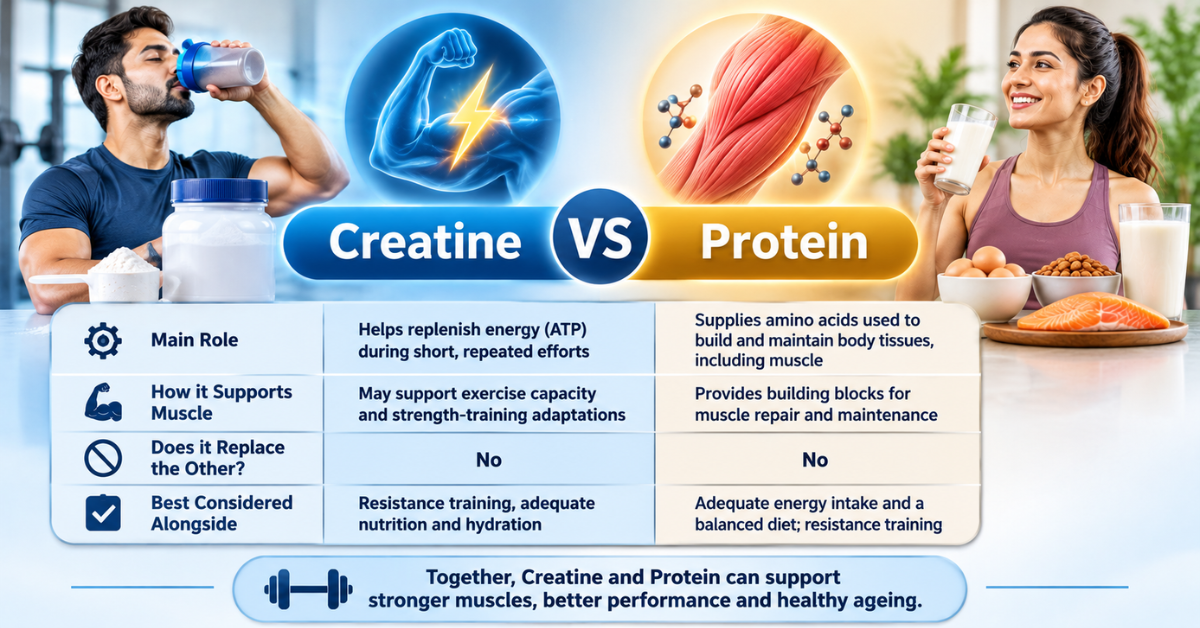
Creatine vs Protein: Both Have Different and Important Roles
Creatine and protein are not alternatives to one another. They support muscle health in different ways, and an adequate intake of both—alongside appropriate resistance exercise—may be important for maintaining muscle strength and function as we age.
Aspect | Creatine | Protein |
Main role | Helps replenish energy (ATP) during short, repeated efforts | Supplies amino acids used to build and maintain body tissues, including muscle |
How it supports muscle | May support exercise capacity and strength-training adaptations | Provides building blocks for muscle repair and maintenance |
Does it replace the other? | No | No |
Best considered alongside | Resistance training, adequate nutrition and hydration | Adequate energy intake and a balanced diet; resistance training |
Key takeaway: Creatine supports the muscle energy system, while protein provides the building blocks muscles need. One does not replace the other. Individual needs vary, particularly with age, activity level, health status and dietary pattern.
Creatine vs Amino Acids: Different Functions
Amino acids are the building blocks of protein. Some amino acids are essential, meaning they must come from the diet. Creatine is a separate compound made by the body from amino acids and stored mainly in skeletal muscle.
Aspect | Creatine | Amino acids |
What they are | A compound involved in rapid energy recycling | Components that make up proteins |
Primary role | Helps regenerate ATP during brief, intense muscle activity | Support protein synthesis and many other body functions |
Dietary source | Produced by the body; also found mainly in meat and fish | Supplied by protein-containing foods and supplements |
Relationship | Does not provide the full range of amino acids needed to build protein | Do not replace creatine’s role in the phosphocreatine energy system |
Amino-acid supplements are not automatically necessary for everyone. A varied diet with sufficient protein can provide essential amino acids; individual requirements should be considered with a qualified professional.
Creatine vs Calcium HMB (β-Hydroxy β-Methylbutyrate)
Creatine and calcium HMB are sometimes discussed in the context of muscle health, ageing and exercise. They are different compounds, and evidence for one should not be used to imply the same effects for the other.
Aspect | Creatine | Calcium HMB |
What it is | A compound stored in muscle and involved in rapid energy recycling | A metabolite of the essential amino acid leucine; often provided as calcium HMB |
Main area of study | Exercise performance and strength adaptations, particularly with resistance training | Muscle protein breakdown and muscle-related outcomes in selected populations |
Evidence context | Research in older adults suggests possible modest additional strength benefits when paired with resistance training; results vary | Research findings vary by population and context; it is not a universal solution for muscle loss |
Can it replace protein or exercise? | No | No |
Neither creatine nor calcium HMB should be presented as a treatment for sarcopenia, menopause-related muscle loss or other medical conditions. A healthcare professional can help assess whether either is appropriate.
Why Consider Creatine Effervescent Granules?
Creatine is available in different formats, including powders, capsules, and effervescent formulations. The choice often depends on convenience, taste, preparation preferences, and the ability to follow a daily routine.
Precimax Creatine Effervescent Granules may be considered by adults who prefer a drink-based format over mixing conventional powder.
Feature | Creatine Effervescent Granules | Conventional Creatine Powder |
Preparation | Dissolved in water according to label instructions | Usually mixed with water or another beverage |
Texture | May offer a smoother drinking experience when fully dissolved | Texture can vary depending on particle size and mixing |
Convenience | Useful for people who prefer a pre-portioned or drink-based routine | Flexible and often easy to measure |
Hydration | Taken with a beverage, contributing to fluid intake | Also requires a suitable beverage for mixing |
Evidence base | Depends on the actual creatine ingredient and formulation | Creatine monohydrate has an extensive research base |
Proven superiority | Cannot be assumed from effervescence alone | Creatine monohydrate remains the most extensively studied form |
Does effervescent creatine absorb faster or work better?
Not necessarily. Effervescence can change how a product dissolves and feels to drink, but it does not automatically establish greater absorption, improved muscle creatine retention, fewer digestive symptoms, or superior clinical outcomes.
A critical review of creatine formulations found insufficient evidence to conclude that effervescent creatine produces greater muscle creatine retention or better performance than conventional creatine monohydrate. (Scientific review of creatine formulations)
For Precimax Creatine Effervescent Granules, any product-specific claims about absorption, gastrointestinal tolerance, or clinical benefits should be supported by evidence for the finished formulation.
Who May Benefit Most from Creatine Supplementation?
Creatine does not produce identical results in everyone. Its suitability depends on health status, diet, exercise, and individual goals.
1. Older Adults Seeking to Maintain Strength
Older adults participating in structured resistance training may consider creatine as a possible adjunct to support strength adaptations. A physiotherapist or healthcare professional can help determine whether supplementation is appropriate.
2. Peri- and Post-Menopausal Women
Changes associated with ageing and menopause can affect muscle and bone health. Creatine may be considered alongside resistance exercise, adequate protein intake, and appropriate bone-health care.
It should not be presented as a treatment for menopause-related muscle loss or osteoporosis, and research findings do not guarantee the same results for every woman.
3. Vegetarians and People Following Plant-Based Diets
Dietary creatine is found mainly in animal-derived foods, so vegetarians and vegans may have lower average muscle creatine stores than people who regularly eat meat. Responses to supplementation can vary, but dietary pattern may be one factor worth discussing with a qualified professional.
4. People Returning to Exercise After Inactivity
After illness, surgery, or a period of reduced activity, rebuilding strength generally requires an individually appropriate rehabilitation programme.
Creatine may be considered in selected cases, but evidence does not establish that it independently prevents disuse muscle loss or accelerates recovery after joint replacement, fractures, or hospitalisation.
People recovering from surgery or acute illness should obtain approval from their treating healthcare team before starting supplementation.

Practical Guidance: Using Creatine Alongside Physiotherapy
Choose an Appropriate Daily Routine
Creatine research commonly uses daily supplementation protocols, but the appropriate amount depends on the individual, product, and clinical context. Do not assume that one protocol is suitable for everyone.
A loading phase is not essential for all supplementation routines. A healthcare professional can help determine an appropriate approach based on the person’s goals and health status.
Pair Supplementation with Structured Exercise
Creatine is not a replacement for resistance training. A physiotherapist may recommend suitable exercises based on strength, balance, joint symptoms, medical history, and functional ability.
Maintain Adequate Nutrition and Hydration
Adequate dietary protein, sufficient energy intake, a varied diet, and appropriate fluid intake are important components of healthy ageing and rehabilitation.
Creatine should complement these measures rather than replace them.
Review Kidney Health and Medication Use
Healthy adults can generally use creatine monohydrate within studied protocols, but people with kidney disease or other significant medical conditions should consult their healthcare professional before use.
Creatine supplementation may increase blood creatinine levels without necessarily indicating kidney damage, so clinicians should know about supplementation when interpreting laboratory results.
Expert Perspectives on Creatine and Healthy Ageing
Dr Pankaj Mehta (PT), Senior Physiotherapist, Mumbai — proposed comment
“Healthy ageing requires more than maintaining muscle size. Strength, functional movement, and the ability to perform daily activities are equally important. Creatine may be considered as an adjunct to a structured resistance-training programme for suitable individuals, with exercise and nutritional needs remaining central to rehabilitation.”
Dr Navneet Singh (PT), Physiotherapist and Sports Medicine Specialist, Delhi — proposed comment
“Creatine should not be viewed as a substitute for physiotherapy. Its potential value lies in complementing an appropriately designed exercise programme. Individual assessment, progressive training, adequate nutrition, and monitoring remain important when supporting strength and mobility in older adults.”