liposomal Lactoferrin has attracted growing scientific interest because of its diverse biological functions. This naturally occurring iron-binding glycoprotein is found in colostrum, milk and several mucosal secretions, where it contributes to host defense, iron regulation and immune-related processes.
But when lactoferrin is consumed orally, an important question arises:
How much of the intact, biologically active protein actually survives gastrointestinal conditions and reaches the sites where it can exert its effects?
This is where liposomal lactoferrin becomes particularly interesting.
Liposomal delivery uses microscopic phospholipid structures to surround or associate with an active ingredient. For a sensitive protein such as lactoferrin, this approach is designed to provide additional protection during gastrointestinal transit and potentially improve delivery.
Research has demonstrated that bovine lactoferrin can undergo substantial digestion during gastric transit, while more recent research into liposomal lactoferrin has shown promising results for protecting lactoferrin against simulated gastric degradation and improving intestinal delivery.
The result is an important shift in how we think about supplementation:
It is not only about how much lactoferrin you consume—it is also about how effectively it is delivered.
What Is Lactoferrin?
Lactoferrin is an iron-binding glycoprotein belonging to the transferrin family. It is naturally present in human and bovine milk, colostrum and various mucosal secretions.
Beyond its ability to bind iron, lactoferrin has been investigated for several biological functions, including:
- Immune modulation
- Antimicrobial activity
- Regulation of iron metabolism
- Gut-barrier support
- Interaction with inflammatory pathways
- Protection of mucosal surfaces
This multifunctionality has made lactoferrin an interesting ingredient for nutritional and nutraceutical applications.
However, lactoferrin is also a protein, and proteins can be sensitive to the gastrointestinal environment.
That creates an important delivery challenge.
Why Conventional Oral Lactoferrin Can Face Delivery Challenges
When a conventional lactoferrin supplement reaches the stomach, it encounters a highly acidic environment and digestive enzymes.
The protein can therefore undergo digestion before reaching the small intestine.
Importantly, this does not mean that conventional lactoferrin is ineffective.
In fact, research in healthy adults found that substantial amounts of bovine lactoferrin survived gastric transit. In a 2001 randomized crossover study involving 12 healthy volunteers, researchers measured gastric survival of different bovine lactoferrin preparations and reported survival ranging from approximately 62% to 79% under the study conditions.
This finding is important because it gives us a more accurate picture.
The question is not:
“Does lactoferrin survive the stomach?”
Rather:
“Can delivery technology help preserve and deliver more of the intact protein under appropriate conditions?”
This is one of the reasons researchers are investigating encapsulation and liposomal delivery systems.
What Is Liposomal Lactoferrin?
Liposomal lactoferrin is lactoferrin delivered using liposomes—microscopic vesicles made primarily from phospholipids.
Phospholipids are important components of biological membranes. A liposome can form a surrounding structure around an active compound, creating a delivery system that differs from simply consuming the free ingredient.
In simple terms:
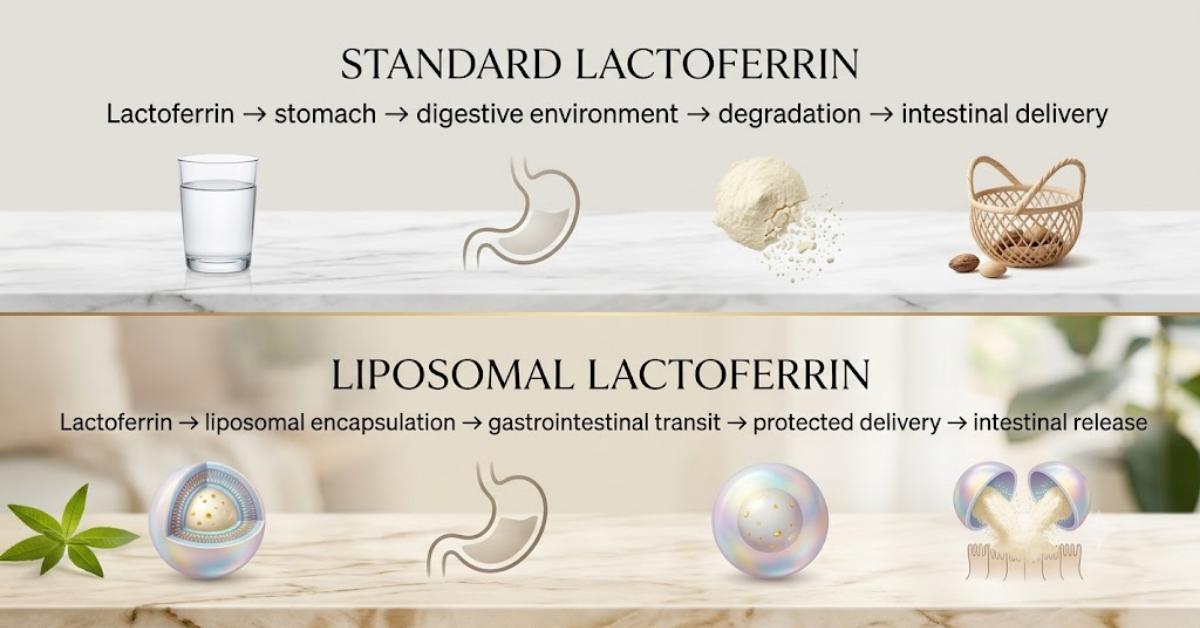
Standard lactoferrin
Lactoferrin → stomach → digestive environment → degradation → intestinal delivery
Liposomal lactoferrin
Lactoferrin → liposomal encapsulation → gastrointestinal transit → protected delivery → intestinal release
The purpose is not simply to increase the amount of lactoferrin in a capsule.
The objective is to improve how the ingredient is delivered.
Research on liposomal systems has investigated their ability to improve stability, permeability, bioavailability and controlled release of sensitive compounds.
How Can Liposomal Technology Support Lactoferrin Delivery?
1. Protection During Gastrointestinal Transit
One of the most important potential advantages of liposomal delivery is physical protection.
Lactoferrin is exposed to digestive conditions after oral consumption. A liposomal structure can provide an additional barrier around the protein.
This may reduce its direct exposure to digestive enzymes and help preserve the protein during part of its gastrointestinal journey.
Recent research published in Foods in 2025 provides particularly interesting evidence. Researchers developed lactoferrin-loaded liposomal nanoparticles and found that the liposomal formulation retained more than 80% intact lactoferrin after 120 minutes in simulated gastric conditions, while free lactoferrin was completely hydrolyzed within 30 minutes in that experimental model.
However, this was an experimental formulation and laboratory model—not a human clinical trial—so these findings should not automatically be translated into identical results in people.
2. Improved Intestinal Stability
The small intestine is an important site for nutrient interactions and biological activity.
A delivery system that helps preserve lactoferrin during gastric transit could potentially increase the amount of intact protein reaching the intestinal environment.
The 2025 Foods study reported that its liposomal lactoferrin formulation protected lactoferrin during simulated gastric digestion and subsequently released it under simulated intestinal conditions. Researchers also observed longer gastrointestinal retention in animal experiments.
This provides scientific support for the delivery concept, although further human research is needed to determine the extent to which these findings translate into clinical outcomes.
3. Potentially Improved Bioavailability
Bioavailability refers broadly to the proportion of a substance that becomes available to the body after administration.
For protein-based nutraceuticals, this concept is especially important.
Consuming 100 units of an ingredient does not necessarily mean that 100 units remain intact and available for biological interaction.
Liposomal delivery is therefore being investigated as a way to improve the stability and availability of sensitive compounds.
A 2023 study comparing free and liposomal bovine lactoferrin reported that liposomal encapsulation increased permeability, bioavailability and time release in the experimental system. The researchers also found stronger antiviral activity for liposomal lactoferrin than free lactoferrin at non-cytotoxic doses in cell-based experiments.
Again, these are in-vitro findings, so they should not be interpreted as proof that liposomal lactoferrin produces the same antiviral effect in humans.
Liposomal Lactoferrin vs Standard Lactoferrin
The major difference is the delivery system.
Parameter | Standard Lactoferrin | Liposomal Lactoferrin |
Delivery | Free lactoferrin | Phospholipid-based delivery system |
Gastrointestinal exposure | Direct exposure | Designed to provide additional protection |
Stability | Can be affected by digestive conditions | Encapsulation may improve stability |
Intestinal delivery | Depends on survival through digestion | Designed to improve delivery of intact lactoferrin |
Bioavailability | Can vary with formulation | Potentially improved through advanced delivery |
Research | Established lactoferrin research | Growing research into encapsulated delivery |
It is important not to interpret this comparison as meaning that conventional lactoferrin does not work.
Instead, liposomal technology represents an additional formulation strategy designed to address some of the delivery challenges associated with sensitive bioactive molecules.
Does Liposomal Lactoferrin Have Better Clinical Results?
This question needs a careful answer.
The scientific rationale for liposomal lactoferrin is strong enough to justify continued research, and experimental studies have demonstrated improvements in stability, delivery and certain biological activities.
However, better formulation performance does not automatically mean better clinical outcomes in humans.
For example, the 2023 antiviral study demonstrated stronger activity of liposomal lactoferrin compared with free lactoferrin in cell-based experiments.
The 2025 lactoferrin-loaded liposome study demonstrated improved gastric protection and intestinal effects in laboratory and animal models.
These findings support the delivery concept, but they should not be presented as evidence that liposomal lactoferrin treats infections, inflammation or other diseases in humans.
For nutraceutical communication, the strongest and most defensible message is:
Liposomal technology may improve the stability and delivery of lactoferrin, while human clinical evidence continues to develop.
Liposomal Lactoferrin and Gut Health
The gastrointestinal tract is particularly relevant to lactoferrin research because it is one of the first biological environments encountered after oral consumption.
Lactoferrin has been investigated for its interaction with intestinal tissues, immune cells and microbial environments.
By potentially preserving more intact lactoferrin during gastrointestinal transit, liposomal delivery may offer an opportunity to optimize its interaction with the intestinal environment.
The 2025 study is particularly relevant here because the researchers specifically investigated intestinal stability and bioactivity of lactoferrin-loaded liposomes. Their experimental formulation showed protection against simulated gastric degradation and release under simulated intestinal conditions.
This is one of the strongest scientific arguments for studying liposomal lactoferrin further.
Liposomal Lactoferrin and Immune Support
Lactoferrin is widely studied for its immunomodulatory and antimicrobial properties.
Its biological activity has been associated with interactions involving immune cells, microorganisms and inflammatory signaling pathways.
Liposomal delivery may potentially enhance the availability of intact lactoferrin for these interactions.
However, it is important to distinguish biological potential from proven clinical benefit.
Research demonstrating activity in cells or experimental models can help explain mechanisms, but it does not establish that a supplement will prevent or treat a specific disease.
Therefore, liposomal lactoferrin is best understood as an advanced delivery approach for a biologically active protein, rather than a replacement for medical treatment.
What Does the Research Say About Liposomal Lactoferrin?
Several areas of research are now contributing to the scientific discussion.
Gastric survival
The 2001 human study by Troost and colleagues demonstrated that a substantial proportion of orally administered bovine lactoferrin survived gastric transit under the experimental conditions.
Liposomal antiviral activity
A 2023 study compared free and liposomal bovine lactoferrin in cell-based models involving HCoV-229E and SARS-CoV-2 pseudoviruses. Liposomal lactoferrin showed stronger antiviral activity at the tested non-cytotoxic concentrations.
Intestinal stability
A 2025 Foods study developed lactoferrin-loaded liposomal nanoparticles and found substantially improved protection against simulated gastric degradation, along with intestinal release and beneficial effects in an animal model of radiation-induced intestinal injury.
Together, these studies support an important scientific direction:
Protecting and delivering lactoferrin effectively may be just as important as the amount of lactoferrin consumed.
What About LipoDuo Lactoferrin?
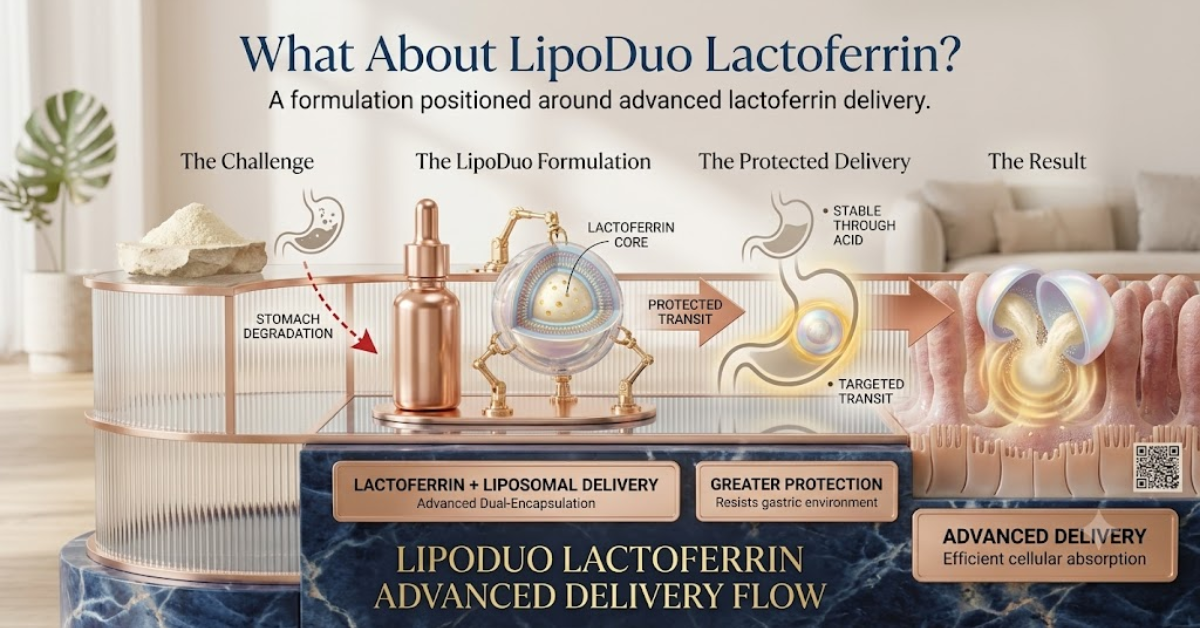
A formulation such as LipoDuo Lactoferrin can be positioned around the concept of advanced lactoferrin delivery.
The central formulation story is:
Lactoferrin + Liposomal Delivery → Greater Protection → Advanced Delivery
When communicating product-specific superiority claims, however, the claim should always be connected to the actual formulation data and supporting documentation.
If comparative data demonstrate higher bioavailability for a specific LipoDuo formulation versus a specific conventional lactoferrin comparator, that result should be presented with the relevant study methodology, formulation, comparator, population and test conditions.
Avoid turning a product-specific comparison into a universal statement that all liposomal lactoferrin is superior to all conventional lactoferrin.
How to Evaluate a Liposomal Lactoferrin Supplement
Consumers should look beyond the word “liposomal” on a label.
Consider:
1. Lactoferrin source
Check whether the product clearly identifies bovine or another source of lactoferrin.
2. Actual lactoferrin quantity
Look at the amount provided per serving.
3. Delivery technology
Understand what the manufacturer means by “liposomal.”
4. Supporting evidence
Look for product-specific studies rather than relying only on general liposome research.
5. Quality testing
A transparent Certificate of Analysis can provide information about identity, purity and other quality parameters.
6. Manufacturing information
Clear information about formulation and manufacturing practices adds credibility.
7. Scientific transparency
The strongest brands distinguish between laboratory evidence, animal research and human clinical evidence.
Why Delivery Technology Matters
The future of nutraceutical formulation is increasingly moving beyond the question:
“How much of the ingredient is in the capsule?”
The more useful question is:
“How effectively is that ingredient delivered?”
For sensitive proteins such as lactoferrin, gastrointestinal stability can influence the amount of intact material available after oral consumption.
Liposomal technology offers a scientifically plausible way of addressing this challenge by using phospholipid vesicles to create a protective delivery environment.
Current research supports several promising areas—including gastrointestinal stability, intestinal delivery and biological activity—but additional well-designed human studies are needed to determine the magnitude of clinical advantages.
That distinction is important.
Liposomal lactoferrin is promising technology, not a shortcut around evidence.
Quick Answers About Liposomal Lactoferrin — AEO
What is liposomal lactoferrin?
Liposomal lactoferrin is lactoferrin delivered using microscopic phospholipid vesicles called liposomes. The delivery system is designed to protect the protein during gastrointestinal transit and potentially improve its stability, bioavailability and delivery to intestinal tissues.
How does liposomal lactoferrin work?
Liposomal lactoferrin surrounds or associates lactoferrin with phospholipid structures. These structures can provide additional protection against environmental and enzymatic degradation and may facilitate delivery of the active protein. Research has demonstrated improved stability and delivery in experimental models.
Is liposomal lactoferrin better than regular lactoferrin?
Liposomal formulations may offer delivery and stability advantages, but the evidence depends on the specific formulation. Research has shown promising results in laboratory and animal models, while direct human comparisons remain more limited.
Does liposomal lactoferrin have higher bioavailability?
Liposomal encapsulation is designed to improve the availability of sensitive compounds, and experimental lactoferrin studies have reported improved bioavailability-related characteristics. However, bioavailability should be evaluated using formulation-specific evidence rather than assuming every liposomal product performs identically.
Is liposomal lactoferrin good for gut health?
Lactoferrin has been investigated for its interactions with intestinal tissues and immune processes. Liposomal delivery may help protect lactoferrin during gastrointestinal transit, potentially improving its intestinal delivery. Human clinical evidence should be considered separately from laboratory and animal findings.
Can liposomal lactoferrin support immunity?
Lactoferrin has documented immunomodulatory and antimicrobial activity in scientific research. Liposomal delivery is being studied as a way to improve its stability and delivery. However, a supplement should not be described as preventing or treating infections unless supported by appropriate clinical evidence.
What is the difference between liposomal and standard lactoferrin?
The primary difference is the delivery system. Standard lactoferrin is consumed as the free protein, whereas liposomal lactoferrin uses phospholipid vesicles as a delivery structure intended to improve stability and delivery.
Does liposomal technology protect lactoferrin from stomach acid?
Experimental evidence suggests that liposomal encapsulation can protect lactoferrin against simulated gastric degradation. A 2025 study reported substantially greater preservation of lactoferrin in simulated gastric conditions using its liposomal formulation.