
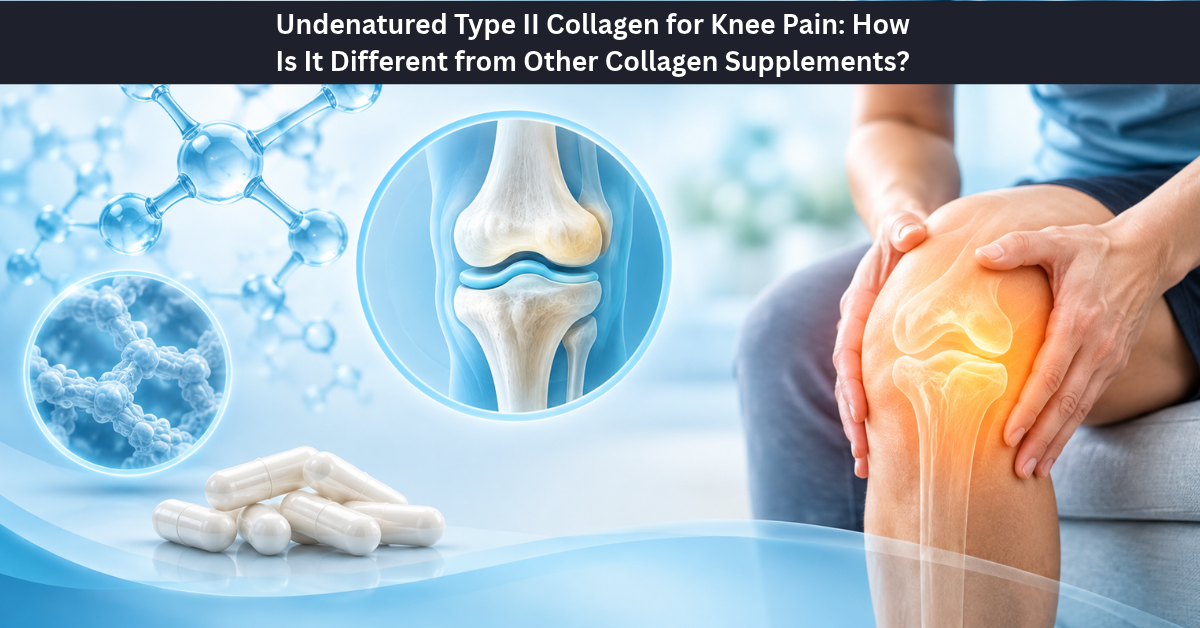
Undenatured type 2 collagen for knee pain – Knee pain can make everyday activities such as walking, climbing stairs, exercising and standing up after sitting uncomfortable. For people experiencing activity-related knee discomfort or early knee osteoarthritis, collagen supplements are often considered as a potential addition to a joint-health routine.
However, not all collagen supplements work in the same way. Hydrolysed collagen peptides are broken down into smaller protein fragments, while undenatured Type II collagen retains important structural features of native collagen. This difference has led researchers to investigate whether these two forms may support joint health through different biological mechanisms.
So, can undenatured Type II collagen help with knee pain, and how does it compare with other collagen supplements?
Research suggests that undenatured Type II collagen may improve certain measures of knee discomfort and physical function in some people. However, the evidence remains limited, and results from individual clinical trials have not always been consistent.
This article explains how undenatured Type II collagen works, what clinical studies show, how it differs from hydrolysed collagen, and what to consider before choosing a supplement.
1. Why Does Knee Pain Develop?
The knee is a complex joint involving cartilage, bones, ligaments, tendons, muscles and other supporting tissues. Healthy cartilage covers the ends of the bones and helps them move smoothly against each other.
Knee osteoarthritis (OA) develops when changes occur throughout the joint. These may include cartilage deterioration, changes in the underlying bone, inflammation of the joint lining and alterations in surrounding tissues.
Common symptoms include:
- Pain during walking, climbing stairs or other activities.
- Stiffness after waking up or sitting for a prolonged period.
- Swelling or tenderness around the joint.
- Reduced mobility and difficulty performing everyday activities.
Age, previous injuries, body weight, genetics and other factors may contribute to osteoarthritis risk. Knee pain can also arise from conditions unrelated to OA, so persistent symptoms should be assessed by a healthcare professional.
Because cartilage contains collagen, researchers have investigated whether specific collagen preparations could help support joint comfort and function. However, knee osteoarthritis is not simply a collagen deficiency, and taking collagen does not automatically repair damaged cartilage.
2. What Is Collagen, and Why Does Its Type Matter?
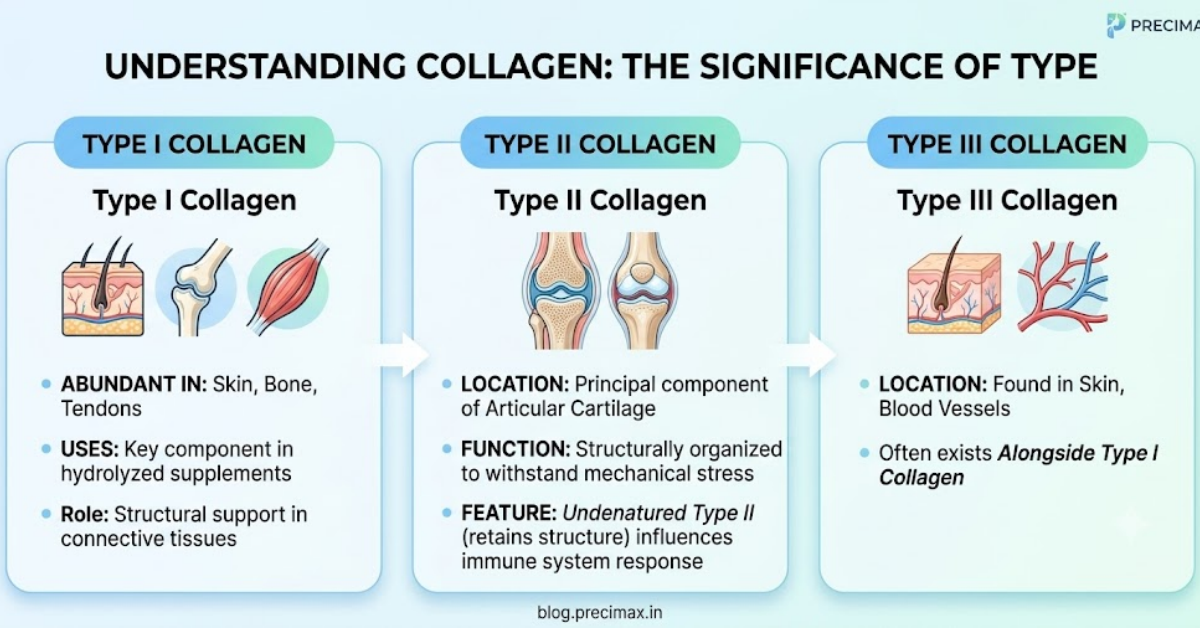
Collagen is a structural protein found in connective tissues throughout the body. Different collagen types have different distributions and biological roles.
Type I collagen
Type I collagen is abundant in skin, bone, tendons and many other connective tissues. It is also a common component of hydrolysed collagen supplements.
Type II collagen
Type II collagen is the principal collagen type in articular cartilage. Its structural organisation contributes to the properties of cartilage that allow it to withstand mechanical stress.
Undenatured Type II collagen has attracted research interest because its retained structural features may influence how the immune system responds to it.
Type III collagen
Type III collagen occurs in tissues such as skin, blood vessels and certain connective tissues. It often exists alongside Type I collagen.
Although these collagen types have different biological roles, the type listed on a supplement label does not, by itself, prove that the product will improve joint symptoms.
The processing method matters too. Hydrolysed collagen and undenatured Type II collagen can differ substantially even when both originate from collagen-containing tissue.
3. Undenatured vs Hydrolysed Collagen: What Is the Difference?
The key distinction is how the collagen is processed and the biological approach being investigated.
<text size=”sm” color=”secondary”>The following comparison describes general characteristics; clinical effects depend on the specific preparation and evidence.</text>
Feature | Undenatured Type II collagen | Hydrolysed collagen peptides |
Processing | Retains important native structural features | Broken down into smaller peptides |
Common format | Capsules | Powders, sachets and drinks |
Typical research dose | 40 mg/day in a notable UC-II trial | Gram-level doses in many studies |
Proposed approach | Investigated for immune-mediated oral tolerance | Studied as a source of collagen-derived peptides and amino acids |
Research focus | Knee discomfort, stiffness and function | Joint symptoms and other connective-tissue outcomes |
Key limitation | Evidence remains limited and formulation-specific | Studies vary in dose, formulation and quality |
How does hydrolysed collagen work?
Hydrolysed collagen is broken down into smaller peptide fragments. After consumption, these peptides are digested and absorbed to varying degrees, alongside the amino acids they provide.
Researchers have investigated whether collagen peptides may influence processes related to connective-tissue metabolism and joint symptoms. Some clinical studies report potential improvements in pain, but the results are not definitive.
Hydrolysed collagen is generally studied in gram-level daily doses. This does not make it inherently better or worse than a supplement studied in milligrams.
How is undenatured Type II collagen different?
Undenatured Type II collagen retains structural features that are altered or lost during hydrolysis. This distinction is important because researchers are investigating a different proposed mechanism.
Rather than focusing primarily on supplying collagen-derived peptides and amino acids, undenatured Type II collagen is studied for its potential influence on immune responses involving native Type II collagen.
These approaches should not be considered interchangeable. Nor does the difference establish that one form is universally superior for knee pain.
4. How May Undenatured Type II Collagen Help With Knee Discomfort?
One proposed mechanism for undenatured Type II collagen involves a process known as oral tolerance.
In simple terms, the immune system is continually exposed to substances entering the digestive tract. Under certain conditions, this exposure can encourage immune responses that are more tolerant of a particular substance rather than reacting aggressively to it.
Researchers propose that consuming small amounts of structurally preserved Type II collagen may influence immune responses to native Type II collagen. This could potentially affect immune pathways associated with joint inflammation.
This proposed mechanism differs from the idea of supplying large amounts of protein building blocks for tissue maintenance.
However, several important distinctions should be kept in mind:
- Oral tolerance is a proposed explanation for the effects of undenatured Type II collagen, not proof that every product produces this response.
- A biological mechanism does not establish that a supplement will provide noticeable symptom relief.
- Improvements in pain or function do not necessarily mean cartilage has regenerated.
- UC-II should not be described as reversing osteoarthritis or replacing established treatment.
The mechanism provides a scientific reason to investigate this ingredient, but its practical value must be judged using human clinical evidence.
5. What Does Clinical Research Show About UC-II for Knee Pain?
Human research on undenatured Type II collagen has produced encouraging findings, but the available evidence is not conclusive.
The 2016 randomised controlled trial
A multicentre, randomised, double-blind, placebo-controlled study published in Nutrition Journal evaluated undenatured Type II collagen in people with knee osteoarthritis.
The trial enrolled 191 participants and compared a specific UC-II preparation at 40 mg daily with placebo and glucosamine plus chondroitin over 180 days.
The researchers reported improvements in WOMAC measures in the UC-II group, including outcomes related to pain, stiffness and physical function. The study also reported favourable findings for certain other symptom measures.
WOMAC stands for the Western Ontario and McMaster Universities Osteoarthritis Index. It is a commonly used research tool that evaluates osteoarthritis-related pain, stiffness and physical limitations.
These findings are relevant because the study evaluated patient symptoms rather than relying solely on laboratory measurements.
However, one trial cannot establish that every undenatured Type II collagen product will produce the same results. The findings also do not demonstrate that the supplement repairs or regenerates cartilage.
Read the 2016 clinical trial in Nutrition Journal.
What does the wider evidence suggest?
A 2023 review and limited meta-analysis examined eight randomised controlled trials involving UC-II in knee osteoarthritis. The authors reported favourable findings for some measures of pain and function, while emphasising that the available literature was limited and larger studies were needed.
The review is useful because it considers several trials rather than relying on a single result. Nevertheless, the number of participants across the included studies remained relatively small, and differences in study designs and outcomes limit how confidently the findings can be generalised.
Read the 2023 review in the American Journal of Translational Research.
What about newer research?
A 2026 randomised clinical trial evaluated UC-II 40 mg daily against placebo, prescription-grade glucosamine sulfate and diacerein in 216 Thai adults with mild-to-moderate knee osteoarthritis. Treatment lasted 24 weeks, with follow-up to 36 weeks.
Importantly, the trial did not find UC-II superior to placebo on its primary outcome: total WOMAC score at week 24. This result adds an important qualification to earlier positive findings.
Read the 2026 randomised clinical trial.
Taken together, these studies show why balanced interpretation matters. Some trials report improvements, while newer evidence has not consistently confirmed a benefit on the primary outcome.
Overall, undenatured Type II collagen is a promising area of joint-health research, but it is not a proven solution for everyone with knee pain. Further well-designed studies are needed to clarify who may benefit, how large the benefit may be and how consistently it can be reproduced.
6. Who Might Consider Undenatured Type II Collagen?
Adults experiencing activity-related knee discomfort or diagnosed with early knee osteoarthritis may be interested in discussing UC-II supplementation as one possible part of their joint-health plan.
It may be worth evaluating if you:
- Want to understand the evidence for a native Type II collagen preparation.
- Prefer a capsule-based supplement rather than a gram-dose powder.
- Are comparing joint-health supplements and want to understand their different mechanisms.
- Want to consider nutritional support alongside appropriate exercise and medical guidance.
However, suitability depends on your health circumstances, the product’s ingredients and the evidence supporting the exact preparation.
People with persistent pain, recurrent swelling, significant mobility limitations or symptoms following an injury should seek medical assessment rather than relying on supplements alone.
7. What Is the UC-II 40 mg Dosage?
A specific undenatured Type II collagen preparation was evaluated at 40 mg per day in the 2016 clinical trial and in the 2026 trial described above.
This is a studied dose, not a universal prescription for all products containing Type II collagen.
When evaluating a supplement, check:
- Whether the ingredient is explicitly identified as undenatured Type II collagen.
- The actual amount per daily serving.
- Whether the clinical research relates to the same preparation.
- The recommended use and precautions on the product label.
- Whether other ingredients introduce additional safety considerations.
Do not assume that 40 mg of one collagen preparation is equivalent to 40 mg of hydrolysed collagen, or that any product containing Type II collagen has the same clinical evidence.
Consult a qualified healthcare professional if you are unsure whether a supplement is suitable for you, particularly if you take medicines or have an underlying medical condition.
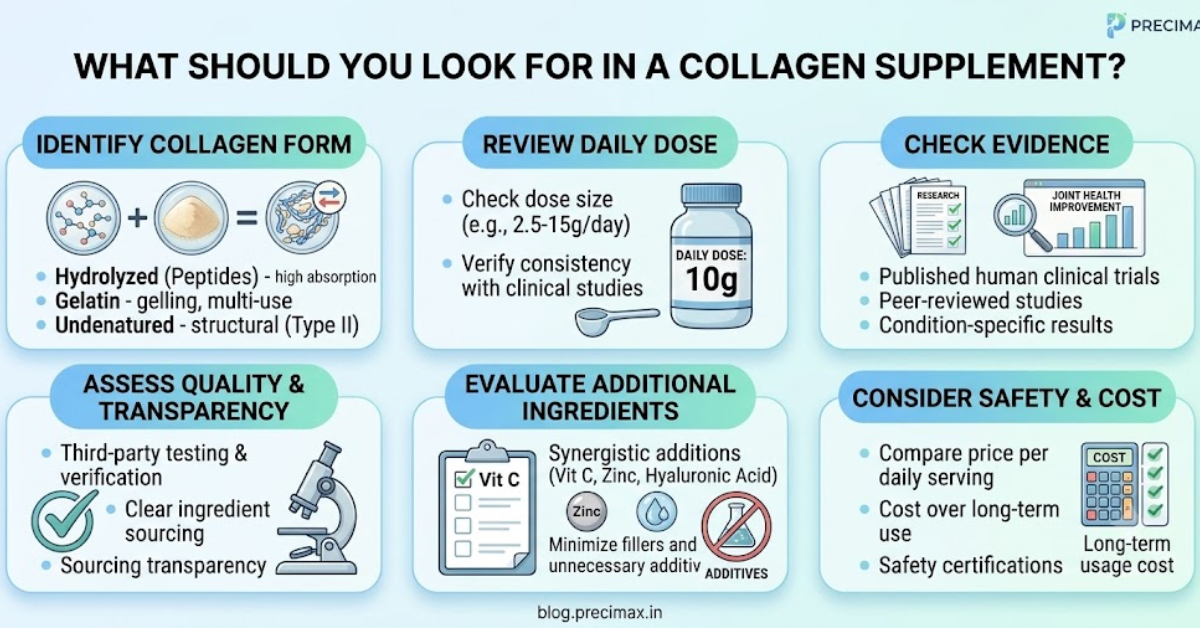
8. What Should You Look for in a Collagen Supplement?
Choosing the best collagen supplement for knee joints requires more than comparing label claims or serving sizes.
Identify the collagen form. Check whether the product contains undenatured Type II collagen, hydrolysed collagen peptides or a combination.
Review the daily dose. Compare the amount of the actual ingredient with the doses investigated in relevant human studies.
Check the evidence. Look for published clinical research and determine whether it evaluates the same ingredient, preparation and intended use.
Assess quality and transparency. Look for clear ingredient sourcing, manufacturer information, batch details and credible quality-testing information where available.
Evaluate additional ingredients. A combination formula may contain other joint-health ingredients, but each should have a clear purpose and appropriate supporting evidence.
Consider safety and cost. Check for potential allergens, possible medicine interactions and the cost of the actual daily serving.
A higher price or longer ingredient list does not establish greater effectiveness. Likewise, a product with a large milligram figure is not automatically more suitable for joint health.
Conclusion: Is Undenatured Type II Collagen Worth Considering for Knee Pain?
Undenatured Type II collagen differs from hydrolysed collagen because it retains important native structural features and is investigated for a proposed immune-mediated oral-tolerance mechanism. Hydrolysed collagen, by contrast, is broken down into smaller peptides and studied through a different nutritional approach.
Clinical trials have reported potential improvements in knee pain and function with some undenatured Type II collagen preparations. However, results are not uniformly positive, and the 2026 trial’s lack of superiority over placebo on its primary WOMAC outcome reinforces the need for realistic expectations.
There is no single best collagen supplement for every person with knee discomfort. The most sensible choice depends on the collagen form, evidence, dose, quality, safety and individual circumstances.
Explore evidence-based approaches to long-term joint health, maintain appropriate physical activity and discuss persistent or worsening knee symptoms with a qualified healthcare professional. Supplements should complement appropriate osteoarthritis care, not replace it.