For decades, physiotherapy has been built around one core principle — movement restores function. Whether an individual is recovering from ACL reconstruction, rotator cuff injury, knee replacement surgery, hip replacement, sports trauma, or age-related muscle weakness, rehabilitation programs depend heavily on progressive exercise to restore strength, mobility, endurance, and confidence.
However, not every patient responds to rehabilitation in the same way.
Some recover rapidly and tolerate increasing exercise intensity, while others experience early fatigue, persistent soreness, slower progress, and prolonged recovery despite following similar treatment plans. Many patients struggle to complete prescribed repetitions, develop muscle exhaustion quickly, and fail to achieve optimal rehabilitation outcomes.
Emerging evidence suggests that one overlooked factor behind poor rehabilitation performance may be inadequate muscular energy availability.
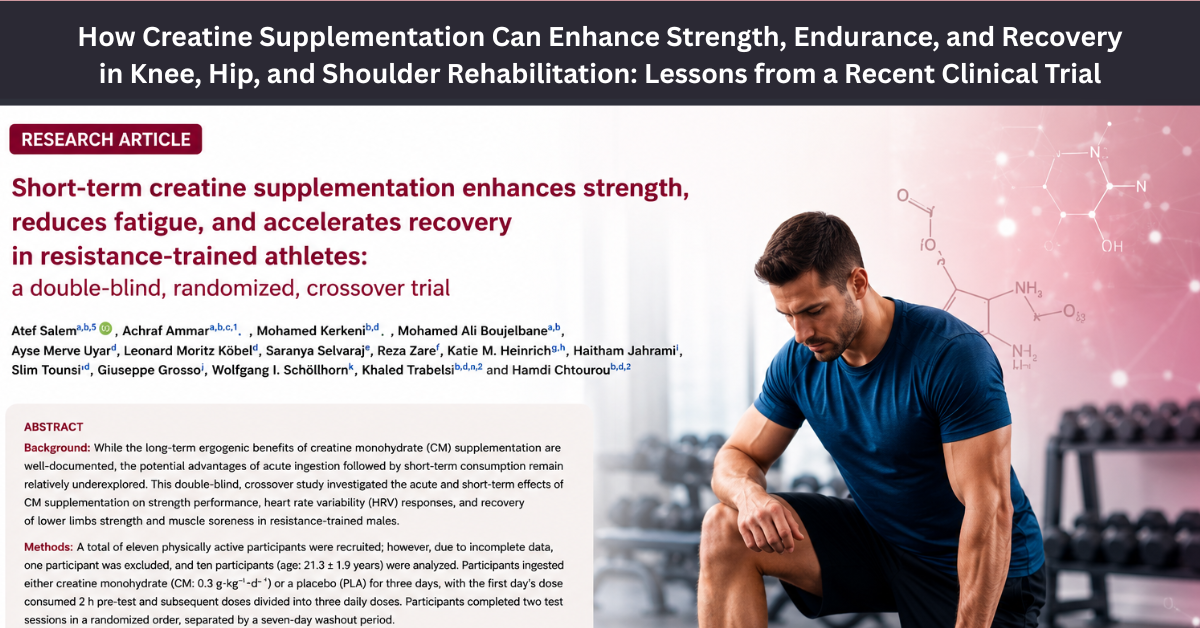
Recent clinical research published in the Journal of the International Society of Sports Nutrition highlighted how creatine supplementation may improve muscular strength, exercise performance, movement efficiency, and post-exercise recovery. Although the study focused on resistance-trained individuals, the underlying physiological benefits have important implications for physiotherapy recovery and modern rehabilitation medicine.
Today, clinicians are increasingly exploring whether creatine for rehabilitation may help patients derive greater benefit from every rehabilitation session.
The Hidden Challenge in Rehabilitation: Inadequate Muscle Reserve
Successful rehabilitation requires repeated muscular contractions performed with adequate intensity and consistency. Unfortunately, many patients begin rehabilitation with significantly compromised muscle reserves.
This is especially common among:
- Post-operative patients
- Elderly individuals with sarcopenia
- Patients with osteoarthritis
- Athletes recovering from injury
- Individuals after prolonged immobilization
- Patients with chronic pain
- Fracture recovery patients
These individuals often demonstrate:
- Reduced muscle mass
- Lower phosphocreatine stores
- Poor muscular endurance
- Delayed recovery
- Reduced exercise tolerance
- Early muscular fatigue
- Difficulty progressing rehabilitation intensity
As a result, rehabilitation sessions may become less productive.
For example, a patient undergoing knee rehabilitation may fatigue after only a few strengthening repetitions. A patient in shoulder rehabilitation may struggle to complete rotator cuff exercises because of muscular exhaustion rather than pain. Similarly, individuals undergoing hip rehabilitation may reduce walking training because of fatigue and weakness.
These limitations often reduce rehabilitation quality and prolong recovery timelines.
What Exactly Is Creatine?
Creatine monohydrate is a naturally occurring compound synthesized from amino acids including glycine, methionine, and arginine. Nearly 95% of the body’s creatine is stored inside skeletal muscles.
Its primary role is to support rapid ATP regeneration.
ATP (adenosine triphosphate) is the body’s immediate energy currency. During muscular contraction:
ATP → ADP + Energy
Once ATP levels decline, muscle performance begins to decrease. Creatine phosphate helps regenerate ATP quickly, allowing muscles to continue producing force efficiently.
In practical terms, creatine functions as the body’s emergency energy reserve system.
Higher muscular creatine stores may help support:
- Better strength output
- Increased repetitions
- Enhanced endurance
- Reduced fatigue
- Faster recovery
- Improved exercise tolerance
These benefits directly address many common challenges observed during joint rehabilitation and physiotherapy programs.
Why the Recent Clinical Trial Matters
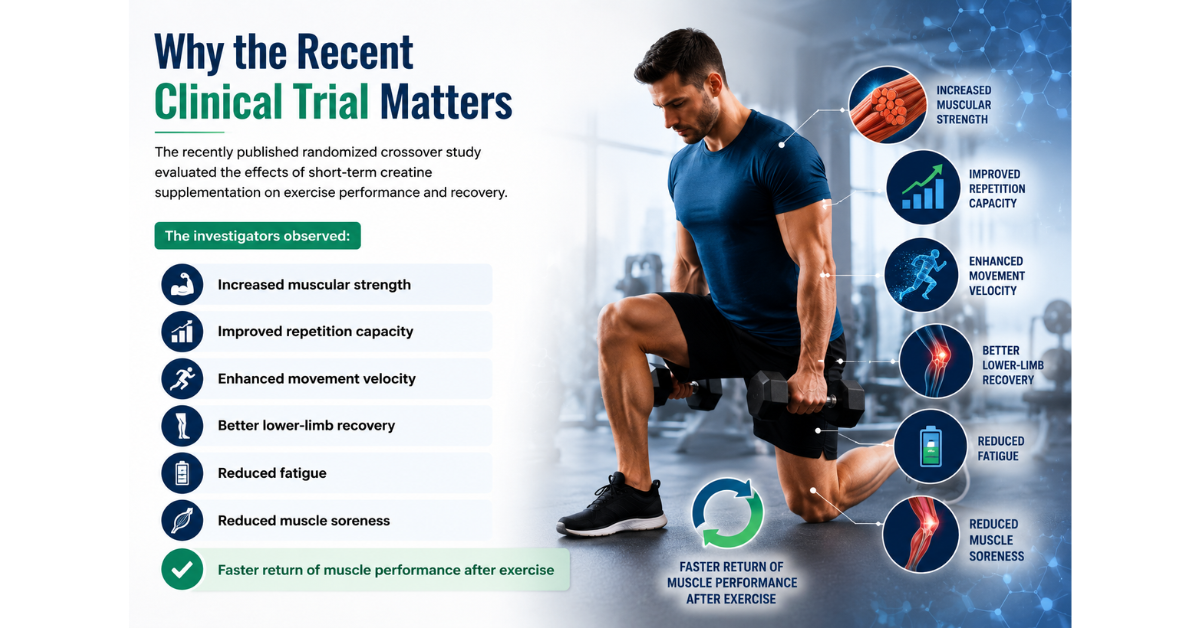
A recently published randomized crossover clinical trial investigated the effects of short-term creatine supplementation on exercise performance and recovery.
The researchers observed:
- Increased muscular strength
- Improved repetition capacity
- Enhanced movement velocity
- Better lower-limb recovery
- Reduced fatigue
- Reduced muscle soreness
- Faster return of muscular performance after exercise
These findings are highly relevant for rehabilitation settings because physiotherapy outcomes depend heavily upon exercise quality, consistency, and recovery capacity.
Patients capable of performing:
- More repetitions
- Higher-quality contractions
- Greater exercise volume
- More consistent therapy sessions
are often more likely to regain functional independence and recover faster.
Why Creatine Deserves Consideration During Rehabilitation
Modern research increasingly recognizes creatine benefits beyond sports performance.
Today, creatine is being explored as a valuable nutritional strategy for rehabilitation support, muscle preservation, and exercise recovery.
Potential benefits may include:
Improved Exercise Capacity
Patients may tolerate greater exercise volumes before muscular fatigue develops.
Enhanced Strength Development
Improved training quality may support better neuromuscular adaptation.
Faster Recovery Between Sessions
Muscles may recover more efficiently following rehabilitation exercises.
Reduced Perceived Fatigue
Lower fatigue levels may improve treatment compliance and patient motivation.
Better Functional Outcomes
Improved muscular strength may support walking, stair climbing, lifting, balance, and mobility.
Muscle Preservation
Particularly valuable during immobilization, post-operative recovery, and elderly rehabilitation.
Creatine for Knee Rehabilitation
Knee rehabilitation often requires intensive quadriceps strengthening and progressive lower-limb loading.
Applicable conditions include:
- ACL reconstruction
- Meniscus repair
- Osteoarthritis
- Patellofemoral pain syndrome
- Total knee replacement
- Sports-related knee injuries
Potential benefits of creatine for recovery may include:
- Improved quadriceps strength
- Better exercise tolerance
- Reduced muscular fatigue
- Enhanced stair-climbing ability
- Faster return to sports activity
- Improved rehabilitation progression
Creatine for Hip Rehabilitation
Patients recovering from hip conditions frequently experience muscular weakness, balance deficits, and reduced endurance.
Conditions may include:
- Hip replacement surgery
- Hip osteoarthritis
- Gluteal weakness syndromes
- Hip labral injuries
- Elderly rehabilitation programs
Potential rehabilitation benefits include:
- Improved gait-training endurance
- Better gluteal activation
- Reduced exercise-related fatigue
- Enhanced balance training
- Greater confidence during mobility exercises
For elderly individuals, elderly muscle support strategies such as creatine may help maintain lean muscle mass and functional independence.
Creatine for Shoulder Rehabilitation
Shoulder rehabilitation often requires repetitive stabilization exercises and progressive strengthening.
Applicable conditions include:
- Rotator cuff injuries
- Shoulder impingement
- Frozen shoulder
- Shoulder instability
- Sports shoulder injuries
Potential benefits may include:
- Improved rotator cuff endurance
- Better scapular stabilization
- Enhanced resistance exercise capacity
- Reduced post-exercise soreness
- Smoother progression through rehabilitation phases
The Role of Creatine in Geriatric Physiotherapy
Aging is commonly associated with reduced muscle mass, lower strength levels, and decreased functional mobility.
Emerging evidence increasingly supports creatine supplementation alongside resistance exercise for older adults.
Potential benefits may include:
- Improved muscular strength
- Better balance and mobility
- Reduced fall risk
- Preservation of lean body mass
- Enhanced independence in daily activities
For elderly patients undergoing physiotherapy, creatine may represent one of the most evidence-supported nutritional strategies currently available.
Cost Versus Benefit Analysis
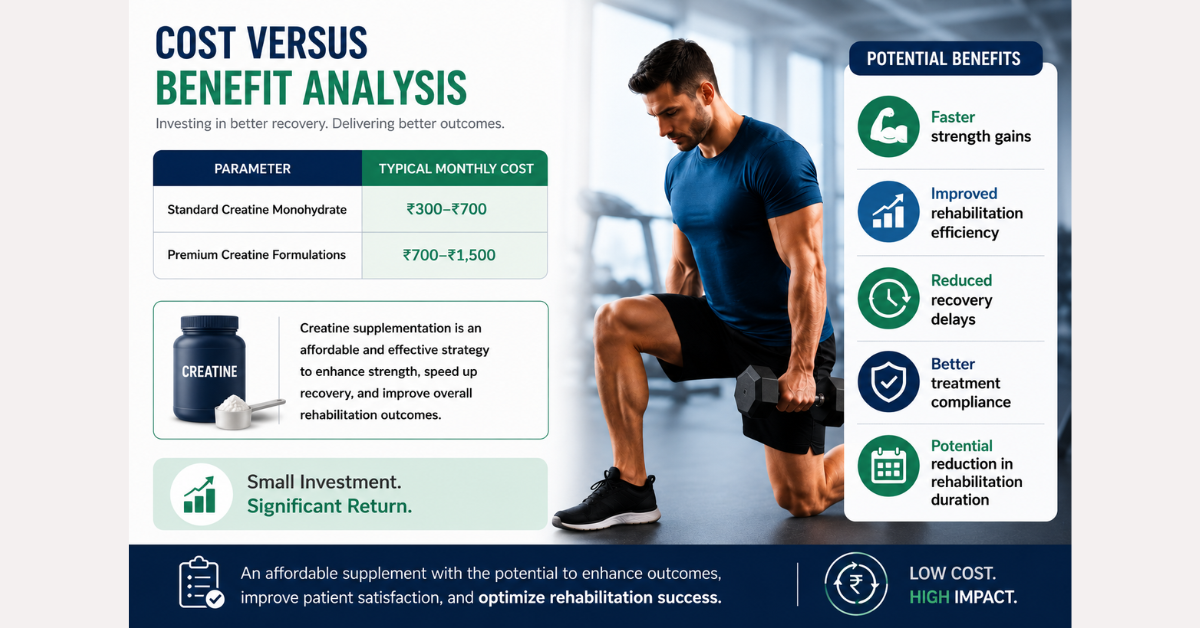
One reason creatine continues to attract attention is its affordability.
Typical Monthly Cost
Product Type | Typical Cost |
Standard Creatine Monohydrate | ₹300–₹700 |
Premium Creatine Formulations | ₹700–₹1,500 |
Potential Benefits
- Faster strength gains
- Improved rehabilitation efficiency
- Reduced recovery delays
- Better treatment compliance
- Potential reduction in rehabilitation duration
Compared with prolonged therapy sessions, delayed return to work, or long-term disability costs, creatine monohydrate remains relatively economical.
Safety Profile of Creatine
Creatine supplementation is among the most extensively studied nutritional interventions in sports and medical literature.
Current evidence supports its safety in healthy individuals when consumed at recommended doses.
Common Myths About Creatine
Myth 1: Creatine Damages Kidneys
Research has not demonstrated kidney damage in healthy individuals using recommended dosages.
Myth 2: Creatine Causes Dehydration
Modern evidence does not support increased dehydration risk.
Myth 3: Creatine Is a Steroid
Creatine is not a hormone and does not possess anabolic steroid activity.
Myth 4: Creatine Is Only for Athletes
Research now supports applications in rehabilitation, aging, muscle preservation, and exercise recovery.
Evolution of Creatine Supplementation: Beyond Traditional Powders
Although traditional creatine monohydrate remains effective, some individuals report challenges such as:
- Poor solubility
- Gritty texture
- Sedimentation
- Digestive discomfort
- Reduced compliance
New-generation formulations such as effervescent creatine granules have been developed to improve convenience and user experience.
Potential advantages include:
- Better water dispersion
- Improved palatability
- Easier consumption
- Greater convenience
- Better long-term adherence
Since rehabilitation outcomes depend heavily on consistency, improving supplement adherence may indirectly support better clinical outcomes.
Creatine vs Protein Supplements: Are They the Same?
Many people incorrectly assume protein supplements and creatine serve identical purposes.
They do not.
Feature | Creatine | Protein |
Primary Role | Cellular energy production | Muscle repair |
Main Function | ATP regeneration | Amino acid supply |
Supports Strength | Yes | Indirectly |
Supports Endurance | Yes | Limited |
Reduces Fatigue | Yes | Minimal |
Supports Recovery | Yes | Yes |
A simple way to understand the difference:
Protein provides the building material.
Creatine provides the energy required for construction.
In many rehabilitation settings, both may play complementary roles.
When Should Creatine Be Taken?
Research suggests flexibility in timing.
Common recommendations include:
- Immediately after physiotherapy sessions
- With breakfast
- Alongside protein shakes
- At any consistent daily time
Current evidence suggests consistency matters more than exact timing.
Why Creatine Should Not Be Taken Alone on an Empty Stomach
Although creatine can be taken alone, absorption and utilization may improve when consumed with:
- Protein
- Milk
- Yogurt
- Fruit smoothies
- Balanced meals
Combining creatine with nutrients that stimulate insulin release may enhance muscle uptake.
Therefore, many clinicians recommend taking creatine alongside meals or protein supplementation rather than separately.
Comparison of Common Creatine Forms
Type | Advantages | Limitations |
Creatine Monohydrate | Most researched and economical | Moderate solubility |
Micronized Creatine | Better mixing | Higher cost |
Creatine Hydrochloride | Improved solubility | Limited long-term evidence |
Buffered Creatine | Marketed for stability | Limited superiority evidence |
Effervescent Creatine Granules | Improved taste and convenience | Higher price |