Why Most Supplements Fail Despite Good Ingredients
Consumers often assume that if a supplement contains clinically proven ingredients, positive results should naturally follow.
After all, if scientific studies show that magnesium supports muscle function, vitamin D supports immunity, or iron supports healthy blood formation, then taking those nutrients should automatically improve health outcomes.
Yet millions of people report a different experience.
Some take supplements consistently but notice little improvement. Others see dramatic benefits from the same nutrient. This raises an important question:
If the ingredient is good, why don’t the results always follow?
The answer lies in a fundamental principle of nutritional science:
A good ingredient does not guarantee a good outcome.
Supplement effectiveness depends on far more than what appears on the label. Absorption, formulation technology, gut health, inflammation, nutrient interactions, genetics, consistency, and duration of use all influence whether a nutrient can actually perform its intended function inside the body.
Understanding these factors helps explain why some supplements succeed while others fail despite containing seemingly excellent ingredients.
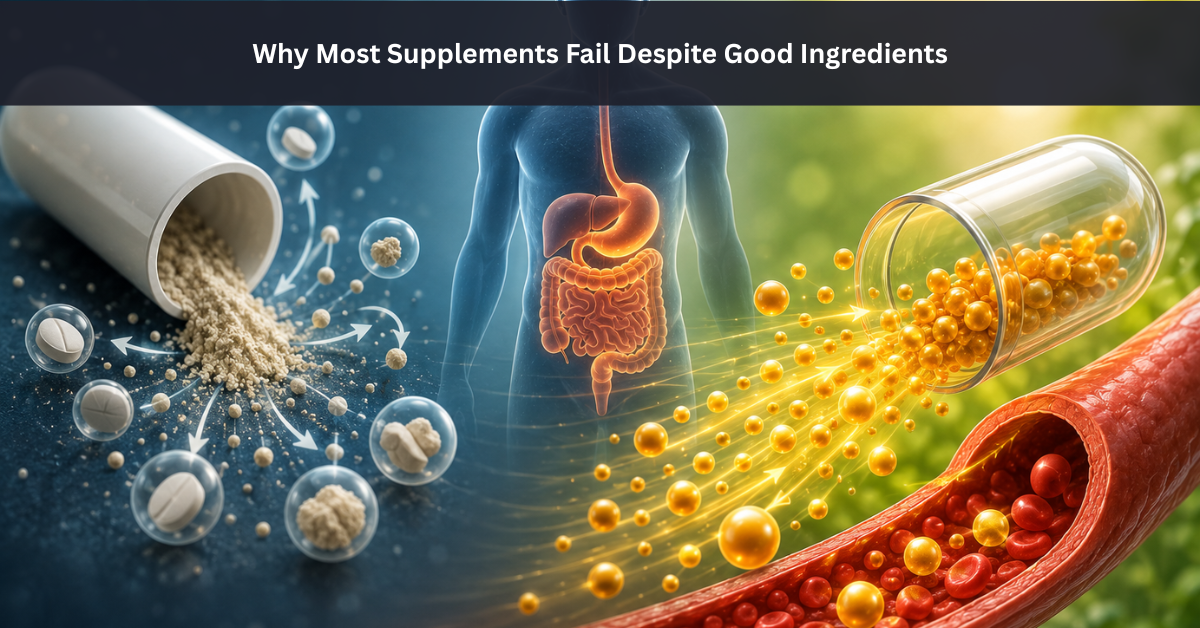
Most supplements fail not because the ingredients are ineffective, but because the body cannot adequately absorb, transport, activate, or utilize those ingredients.
Even clinically validated nutrients can produce disappointing results when bioavailability is poor, formulation quality is inadequate, gut health is compromised, or supplementation is inconsistent.
Key Takeaways
- Good ingredients alone do not guarantee results.
- Absorption often matters more than dosage.
- Bioavailability determines how much of a nutrient the body can actually use.
- Gut health plays a major role in supplement effectiveness.
- Chronic inflammation may impair nutrient utilization.
- Nutrients often work together rather than independently.
- Delivery systems and formulations significantly influence outcomes.
- Consistency and duration are critical for success.
- Genetics contribute to individual responses.
- Better formulations can sometimes outperform higher dosages.
Why Supplement Success Is More Complex Than Ingredient Lists
Many consumers judge a supplement primarily by its ingredient panel.
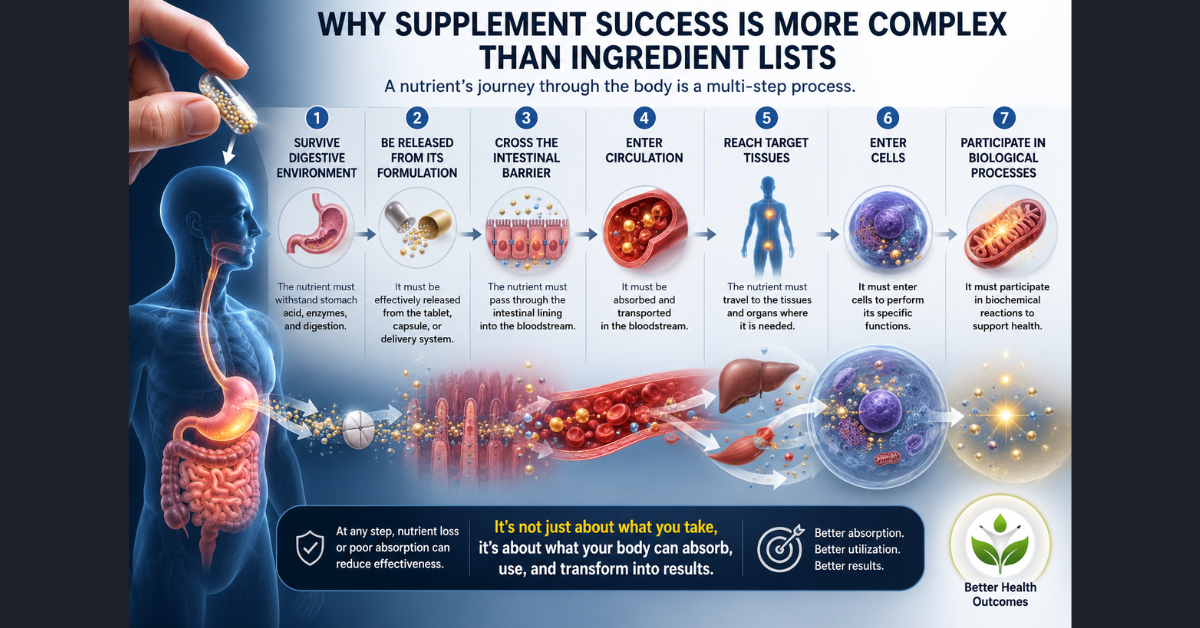
However, a nutrient’s journey through the body is remarkably complex.
A nutrient must:
- Survive the digestive environment.
- Be released from its formulation.
- Cross the intestinal barrier.
- Enter circulation.
- Reach target tissues.
- Enter cells.
- Participate in biological processes.
Failure at any stage can reduce effectiveness.
This is why two supplements containing identical ingredients may produce very different outcomes.
The real question is not:
“What’s inside the supplement?”
The more important question is:
“How much of it actually reaches the cells where it is needed?”
Seven Reasons Supplements Fail
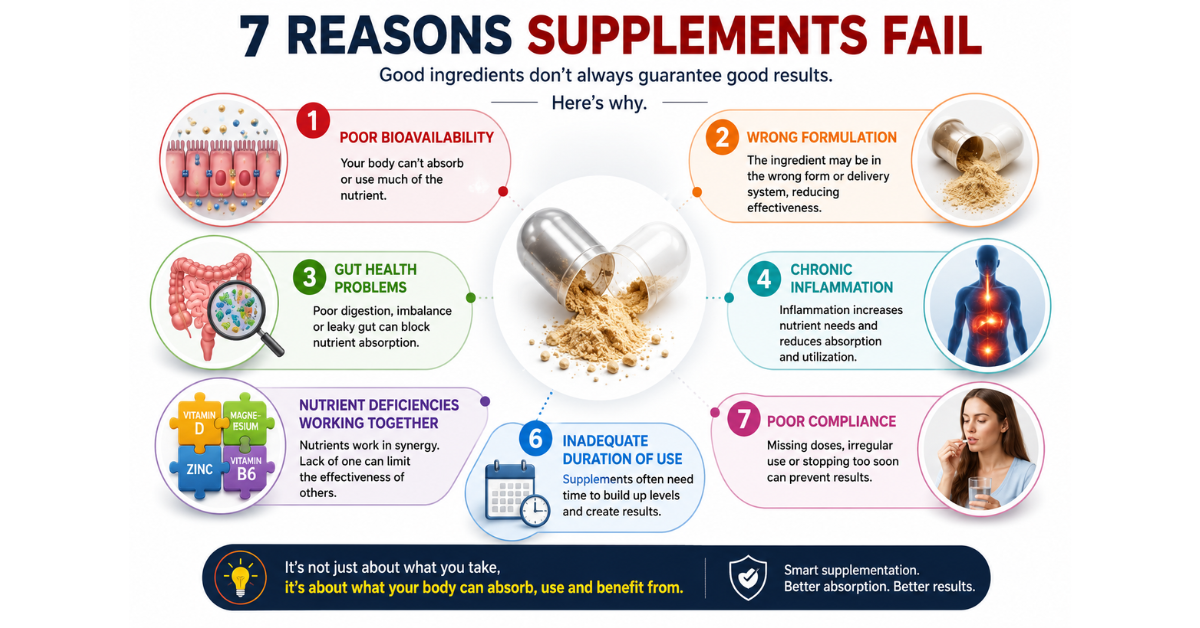
1. Poor Bioavailability
Bioavailability refers to the proportion of a nutrient that becomes available for physiological use after consumption.
Simply swallowing a supplement does not guarantee that the body can use it.
Many nutrients naturally have low bioavailability, including:
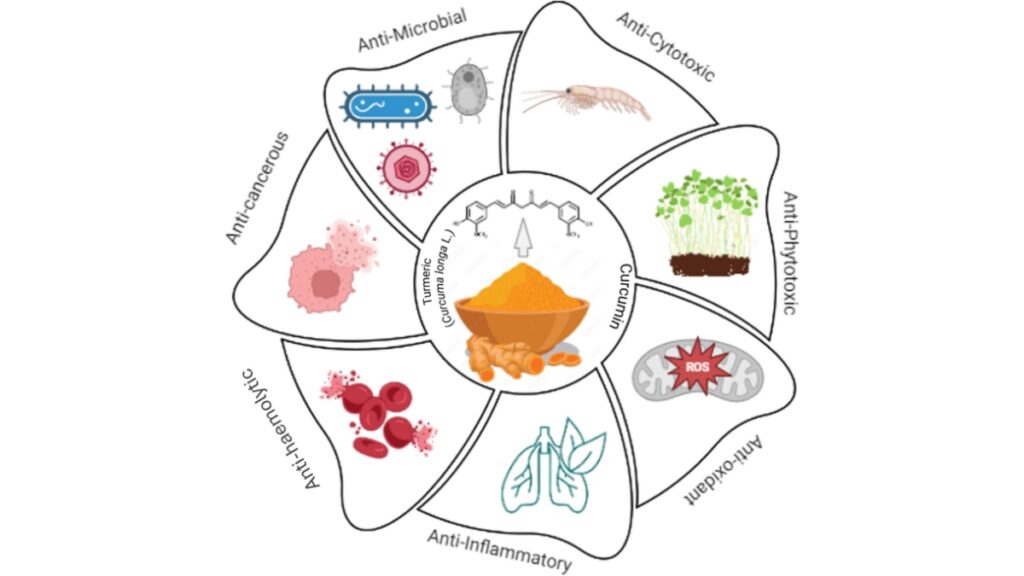
- Curcumin
- Glutathione
- Coenzyme Q10
- Certain magnesium forms
- Certain iron forms
A supplement may contain a large dose, yet only a small fraction may ultimately reach circulation.
This is why modern delivery technologies such as liposomes, phospholipid complexes, chelation, and microencapsulation have gained significant attention.
Key Insight
What matters is not how much you take.
What matters is how much your body actually uses.
2. Wrong Formulation
Consumers often focus entirely on ingredients while overlooking formulation science.
However, the delivery system often determines whether a nutrient reaches its intended destination.
Examples
Liposomal Formulation in Gummies
Liposomal technology relies on delicate phospholipid structures.
When incorporated into gummies, moisture exposure, processing conditions, and storage factors may compromise liposomal integrity, potentially reducing intended absorption benefits.
Magnesium Glycinate in Standard Capsules
Magnesium glycinate is considered a highly absorbable magnesium form.
However, poor manufacturing quality, inadequate dissolution characteristics, or inappropriate excipients may still limit effectiveness.
Curcumin in Oral Disintegrating Film Form
Curcumin naturally exhibits poor water solubility.
While oral disintegrating films may improve convenience, they do not necessarily solve curcumin’s bioavailability challenges unless supported by additional absorption-enhancing technologies.
Key Takeaway
The best ingredient placed in the wrong formulation may perform worse than a well-designed delivery system containing the same ingredient.
3. Gut Health Problems
The digestive system serves as the primary gateway for nutrient absorption.
Conditions such as:
- IBS
- Dysbiosis
- Leaky gut
- Chronic digestive discomfort
- Low stomach acid
can significantly reduce nutrient uptake.
Healthy gut bacteria also contribute to nutrient metabolism and absorption.
Even excellent supplements may underperform when digestive health is compromised.
4. Chronic Inflammation
Inflammation affects nutrient utilization in several ways.
Persistent inflammation may:
- Damage intestinal lining
- Reduce absorption efficiency
- Increase nutrient requirements
- Accelerate nutrient depletion
As a result, individuals experiencing chronic inflammation may require more nutritional support while simultaneously absorbing nutrients less effectively.
This creates a challenging cycle that can reduce supplement effectiveness.
5. Nutrient Deficiencies Often Work Together
The body functions through interconnected biochemical pathways.
Very few nutrients work in isolation.
Vitamin D and Magnesium
Magnesium helps activate vitamin D.
Without adequate magnesium, vitamin D may not function optimally.
Calcium and Vitamin K2
Vitamin K2 helps direct calcium toward bones and away from arteries and soft tissues.
Iron and Vitamin C
Vitamin C enhances iron absorption.
Correcting one deficiency while ignoring supporting nutrients may limit outcomes.
This explains why synergistic formulations often outperform isolated nutrients.
6. Inadequate Duration of Use
Many consumers expect supplements to work quickly.
However, biological repair often requires time.
Examples include:
- Iron repletion may require several months.
- Vitamin D normalization often takes weeks.
- Magnesium stores build gradually.
- Antioxidant support typically requires sustained use.
Discontinuing supplementation prematurely is one of the most common reasons people conclude that a supplement does not work.
7. Poor Compliance
The most advanced formulation cannot work if it is not taken consistently.
Common compliance issues include:
- Missing doses
- Taking supplements irregularly
- Stopping too early
- Incorrect timing
- Failure to follow directions
Clinical trials are conducted under highly controlled conditions.
Real-world consumers often experience different outcomes because adherence is less consistent.
Case Examples
Iron Supplementation
Many individuals remain iron deficient despite supplementation.
Potential causes include:
- Poor absorption
- Digestive intolerance
- Chronic inflammation
- Inappropriate iron forms
Advanced formulations may improve tolerability and absorption.
Vitamin D Supplementation
Some individuals fail to raise vitamin D levels despite taking supplements regularly.
Potential reasons include:
- Fat malabsorption
- Obesity
- Magnesium deficiency
- Poor compliance
Vitamin D requires proper absorption and activation pathways.
Curcumin Supplementation
Curcumin has naturally low bioavailability.
Without advanced formulation technologies, only a small percentage may reach circulation.
Vitamin B Supplementation
Vitamin B12 absorption depends on intrinsic factor production and gastrointestinal health.
Digestive challenges may reduce effectiveness.
Glutathione Supplementation
Traditional glutathione faces stability and absorption challenges.
Modern liposomal delivery systems have been developed to improve bioavailability.
Do Genetics Play a Role?
Absolutely.
Genetic differences influence how nutrients are absorbed, metabolized, transported, and utilized.
Variations may affect:
- Vitamin D metabolism
- Folate utilization
- Iron regulation
- Antioxidant defense systems
- Inflammatory responses
This helps explain why identical supplements may produce different outcomes among different individuals.
Clinical Insight from Precimax
The Supplement Success Equation
Results are rarely determined by ingredients alone.
Results =
Right Ingredient
+ Right Dose
+ Right Delivery System
+ Healthy Absorption
+ Adequate Duration
+ Patient Compliance
When one component is missing, outcomes may be compromised.
At Precimax, formulation decisions are guided by the understanding that successful supplementation requires more than simply including good ingredients.
The objective is to maximize the likelihood that nutrients are absorbed, utilized, and capable of delivering meaningful health benefits.
Practical Tips for Consumers
- Look beyond dosage.
- Evaluate bioavailability.
- Prioritize gut health.
- Consider nutrient synergy.
- Be consistent.
- Follow recommended durations.
- Choose scientifically designed formulations.
- Don’t compare your results directly with others.
- Address inflammation when possible.
- Monitor progress through symptoms and testing.
References
- https://ods.od.nih.gov
- https://www.ncbi.nlm.nih.gov
- https://pubmed.ncbi.nlm.nih.gov
- https://www.frontiersin.org
- https://www.mdpi.com
- https://academic.oup.com
- https://www.sciencedirect.com
- https://www.nature.com
- https://www.who.int
- https://www.cochranelibrary.com
- https://www.nccih.nih.gov
- https://www.efsa.europa.eu
- https://nutritionreviews.org
- https://www.clinicalnutritionjournal.com
- https://www.jandonline.org