
Knee pain can make everyday activities such as walking, climbing stairs, exercising and getting up from a chair increasingly difficult. For people experiencing knee osteoarthritis or age-related joint changes, collagen supplements are often considered as part of a broader joint-health strategy.
The best collagen supplement for knee pain depends on the collagen type, clinical evidence, individual needs and overall treatment plan. Hydrolysed collagen peptides and undenatured Type II collagen (UC-II) have been studied for joint discomfort and physical function, but neither works for everyone, and neither has been proven to reverse osteoarthritis. Best collagen supplement for knee pain
Understanding who may benefit, how to assess suitability, which lifestyle measures complement supplementation and how to evaluate results can help you make a more informed decision.
Important: Collagen supplements are not a substitute for medical assessment, physiotherapy, appropriate exercise or prescribed osteoarthritis treatment.

What Is the Best Collagen Supplement for Knee Pain?
Hydrolysed collagen peptides and undenatured Type II collagen are two collagen forms investigated for joint health. However, there is no universally established best option for everyone with knee pain.
- Hydrolysed collagen peptides: Broken-down collagen proteins generally studied in gram-level daily doses.
- Undenatured Type II collagen (UC-II): A structurally preserved collagen preparation studied at much smaller milligram-level doses.
- Gelatin: A collagen-derived ingredient with more limited direct evidence for treating knee osteoarthritis.
- Combination formulas: Supplements that combine collagen with ingredients such as vitamin C, hyaluronic acid or other joint-health compounds.
A 2024 meta-analysis of 35 randomised controlled trials involving 3,165 participants reported improvements in osteoarthritis pain and physical function with collagen derivatives overall. However, the studies differed in formulation, duration and quality, so the results cannot be applied equally to every collagen product.
Read the published research on PubMed.
1. Who Is Most Likely to Respond Positively to Collagen Supplements?
People with knee osteoarthritis or persistent joint discomfort may experience improvements in pain or physical function with certain collagen preparations, but individual responses vary and improvement is not guaranteed.
Potential candidates include:
Adults with mild-to-moderate knee osteoarthritis
Some clinical studies have reported reduced pain or improved function among people with knee osteoarthritis who took specific collagen preparations. These individuals may consider supplementation as an adjunct to an evidence-based management plan.
However, the evidence does not establish that every person with osteoarthritis will benefit.
Physically active adults experiencing joint discomfort
People who experience activity-related joint discomfort may be interested in collagen supplements. Some research has investigated collagen peptides in physically active populations, although findings from exercise-related studies should not automatically be interpreted as evidence for treating osteoarthritis.
Adults experiencing age-related changes in joint function
Age-related changes can affect cartilage, muscles and other connective tissues. Certain collagen supplements may offer symptomatic benefits for some older adults, but age alone does not predict whether someone will respond.
People who can combine supplementation with consistent rehabilitation
Individuals who follow an appropriate exercise programme, maintain a healthy body weight where relevant and monitor their symptoms may be better positioned to assess whether supplementation provides additional value.
Importantly, a supplement should not be used to compensate for inadequate rehabilitation or untreated underlying conditions.
Who may be less likely to benefit?
People whose knee pain results from an acute injury, infection, inflammatory disease or another condition requiring specific treatment may not benefit from collagen supplementation alone. Evidence is also insufficient to identify reliable individual predictors of response.
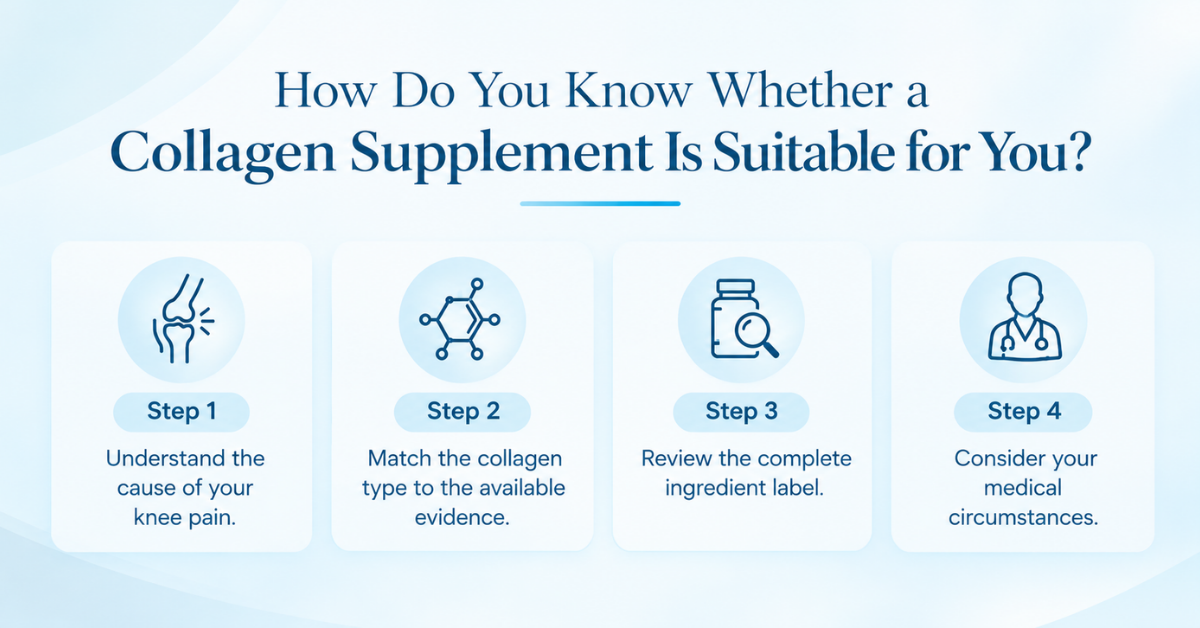
2. How Do You Know Whether a Collagen Supplement Is Suitable for You?
A collagen supplement may be worth considering when your symptoms, health circumstances, product formulation and treatment goals align with the available evidence. A healthcare professional can help determine whether it is appropriate.
Use the following checklist before starting.
Step 1: Understand the cause of your knee pain
Knee pain can result from osteoarthritis, tendon problems, injuries, inflammatory conditions and other causes.
If pain is persistent, worsening or limiting daily activities, seek medical assessment before relying on a supplement.
Step 2: Match the collagen type to the available evidence
Hydrolysed collagen peptides and UC-II differ in processing, composition and the doses used in research.
For example, a randomised controlled trial involving 191 participants evaluated a specific UC-II preparation at 40 mg daily over 180 days. The study reported improvements in overall WOMAC scores, which assess pain, stiffness and physical function.
Read the UC-II clinical trial.
This is evidence for the preparation and study conditions investigated, not proof that every Type II collagen supplement produces the same results.
Step 3: Review the complete ingredient label
Check the collagen source, amount per serving, recommended daily intake, additional ingredients, allergen information and manufacturer details.
A higher milligram amount does not automatically mean greater effectiveness because different collagen forms are studied at different doses.
Step 4: Consider your medical circumstances
Consult a healthcare professional before starting supplementation if you take regular medicines, have significant medical conditions, have known food allergies, or are pregnant or breastfeeding.
Practical takeaway: Suitability depends on more than age or the severity of discomfort. The underlying diagnosis, ingredient formulation, safety profile and realistic expectations all matter.
3. Which Collagen Type Is Best for Knee Joints?
Hydrolysed collagen peptides
Hydrolysed collagen is processed into smaller peptides and commonly sold as powders, sachets and drinks. Research has investigated its potential effects on joint discomfort and physical function.
A 2023 systematic review and meta-analysis of four randomised controlled trials involving 507 participants reported potential pain benefits, although concerns about study bias limited confidence in the findings.
Undenatured Type II collagen (UC-II)
UC-II retains structural features of native Type II collagen. One proposed mechanism involves oral tolerance, whereby exposure to particular collagen structures in the gut may influence immune responses.
A specific preparation has been studied at 40 mg daily, but this is not a universal prescription for all Type II collagen products.
Gelatin and multi-ingredient formulas
Gelatin is a partially denatured collagen-derived ingredient. Combination formulas may include collagen alongside vitamin C, hyaluronic acid, glucosamine, chondroitin or botanical extracts.
The effectiveness of a combination depends on its specific formulation, ingredient quantities and clinical evidence. A longer ingredient list does not establish greater benefit.
4. What Complements Collagen Supplementation for Better Joint Health?
Collagen supplements are best considered alongside appropriate exercise, physiotherapy, weight management when needed and a balanced diet—not as standalone treatments for knee osteoarthritis.
These measures address different aspects of joint health and may be more important to long-term function than supplementation alone.
Physiotherapy and strengthening exercises
Physiotherapy can help improve quadriceps and hip strength, mobility, balance and movement patterns.
A physiotherapist can tailor exercises to your symptoms and physical capacity. Depending on the individual, a programme may include strengthening, range-of-motion exercises, balance training and gradual aerobic activity.
Exercise may cause temporary discomfort when introduced, but the programme can be adjusted to suit your condition. Do not push through severe or rapidly worsening pain.
Weight management when appropriate
For people who are overweight or living with obesity, weight management can reduce mechanical loading on the knees and may improve osteoarthritis symptoms.
A sustainable approach combining appropriate physical activity and dietary changes is generally more useful than extreme weight-loss methods.
Weight loss is not necessary or appropriate for everyone with knee pain; individual needs should guide the approach.
A balanced, anti-inflammatory dietary pattern
A varied dietary pattern rich in vegetables, fruit, whole grains, legumes, nuts and appropriate protein sources supports overall health.
Foods containing omega-3 fatty acids, such as oily fish, can also form part of a balanced diet. However, an anti-inflammatory dietary pattern should not be presented as a cure for osteoarthritis or as a guaranteed way to increase collagen supplement effectiveness.
Adequate protein and vitamin C are important for normal tissue maintenance and collagen formation. Supplements should complement, rather than replace, a nutritious diet.
Appropriate medical care and symptom management
Follow your clinician’s recommendations regarding pain management, physical activity, assistive devices or other treatments.
Do not stop prescribed medication or delay an indicated treatment because you have started taking collagen.
Consistent use and realistic expectations
If a healthcare professional agrees that a collagen supplement is suitable, follow the product’s labelled directions and establish a reasonable period for reviewing the results.
Taking more than the recommended amount is not proven to produce faster or greater benefits.
5. How Do You Know Whether Collagen Is Working for You?
The most useful indicators are measurable changes in pain, stiffness, mobility and everyday function—not simply whether you feel different after taking a supplement.
Because individual responses vary, tracking symptoms before and during supplementation can help you assess whether the product appears worthwhile.
Record your baseline symptoms
Before starting, note your usual pain level, stiffness and activity limitations. A simple 0–10 pain scale may help you compare changes over time.
Record specific activities that are difficult, such as climbing stairs, walking for 15 minutes or standing up from a chair.
Monitor changes consistently
Review the same measures regularly:
- Pain during walking or climbing stairs.
- Morning stiffness or stiffness after sitting.
- Walking distance and exercise tolerance.
- Ease of performing daily activities.
- Need for additional symptom-management measures.
Also record changes in physiotherapy, exercise, weight or medication, as these may influence your results.
When should you expect results?
There is no guaranteed timeline. Studies have assessed outcomes over several weeks to several months, with some knee osteoarthritis trials lasting three to six months or longer.
The 180-day UC-II trial illustrates the duration of one research protocol; it does not mean everyone needs six months to respond or will experience a benefit.
Discuss a reasonable review period with your healthcare professional. If symptoms worsen, do not wait for the supplement to work before seeking assessment.
How do you know if it is not working?
If you notice no meaningful improvement after an appropriate trial period, review the product’s suitability, adherence, tolerability and your broader treatment plan with a healthcare professional.
There is no established home test that can confirm whether collagen supplementation is rebuilding cartilage. Symptom improvement alone also cannot prove that structural joint changes have occurred.
The key principle: Judge the supplement by meaningful changes in function and comfort, alongside safety and cost—not by marketing promises.
6. Can Collagen Be Combined With Vitamin C, Hyaluronic Acid or Other Ingredients?
Some combination formulas are designed to support different aspects of joint health.
- Vitamin C: Contributes to normal collagen formation. This provides a biological rationale for its inclusion, but does not prove that adding it to every collagen product improves knee pain.
- Hyaluronic acid: Has been investigated as an oral supplement for joint symptoms. Evidence depends on the formulation, and findings for oral supplements cannot be transferred directly to joint injections.
- Glucosamine and chondroitin: Common joint-health ingredients with mixed evidence and recommendations.
- Curcumin and Boswellia: Certain extracts have been investigated for osteoarthritis symptoms, but evidence varies by formulation and dose. They may also interact with medicines.
- Probiotics: Research into the gut–joint axis is emerging, but probiotic effects are strain-specific, and it is not established that probiotics necessarily improve collagen absorption or effectiveness.
Choose combination supplements based on transparent ingredient quantities, relevant evidence and safety considerations rather than the number of ingredients advertised.
7. Collagen Supplement Safety, Side Effects and Cost
Collagen supplements have generally been well tolerated in some clinical studies, but they are not suitable for everyone.
Possible considerations include digestive discomfort, allergies to the source ingredient and interactions involving additional ingredients. Collagen may be derived from fish, bovine, porcine or chicken sources, so check the label carefully.
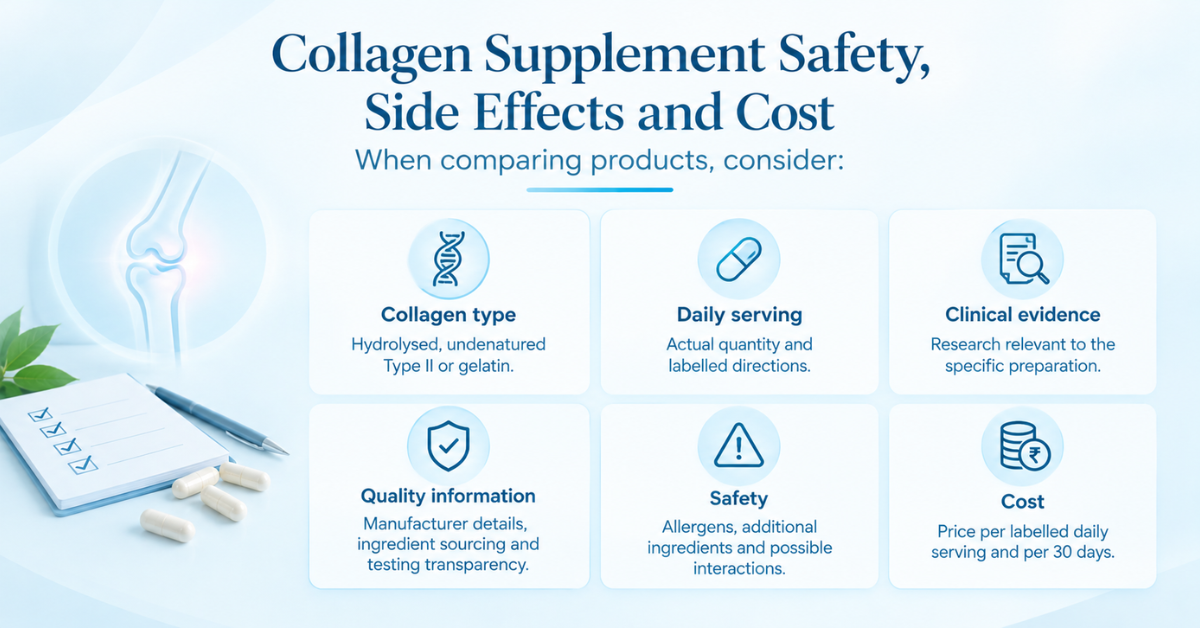
When comparing products, consider:
Factor | What to check |
Collagen type | Hydrolysed, undenatured Type II or gelatin |
Daily serving | Actual quantity and labelled directions |
Clinical evidence | Research relevant to the specific preparation |
Quality information | Manufacturer details, ingredient sourcing and testing transparency |
Safety | Allergens, additional ingredients and possible interactions |
Cost | Price per labelled daily serving and per 30 days |
For example, a product costing ₹1,500 for 30 daily servings costs ₹50 per day. This is an illustrative calculation, not a current market price or product recommendation.
A higher price or larger dose does not automatically indicate better clinical results.
Seek urgent medical evaluation if your knee suddenly becomes hot, red and swollen, particularly if accompanied by fever, or if you cannot bear weight on the affected leg.
Conclusion: Is Collagen Worth Considering for Knee Pain?
Collagen supplementation may help some people with knee osteoarthritis or joint discomfort, but benefits vary and evidence differs between formulations.
The most appropriate choice depends on the collagen type, supporting clinical research, safety, individual circumstances and realistic treatment goals.
For a more complete joint-health strategy, combine informed supplement decisions with appropriate physiotherapy, strengthening exercises, weight management when relevant, a balanced diet and professional medical guidance.
Track changes in pain, stiffness and everyday function to assess whether a supplement appears useful. If symptoms persist or worsen, seek medical assessment rather than relying on supplementation alone.