
Joint pain can make everyday activities—from climbing stairs to enjoying a morning walk—feel like a challenge. With growing awareness of natural health solutions, curcumin supplements have become one of the most popular choices for people looking to support joint comfort and mobility. In fact, curcumin, the primary active compound found in turmeric, is among the most extensively researched plant-derived ingredients for its role in supporting a healthy inflammatory response. Why Isn’t Your Curcumin Working.
Yet many people stop taking curcumin after a few weeks because they don’t notice the improvements they expected.
Does that mean curcumin doesn’t work?
Not necessarily.
In many cases, the problem isn’t the ingredient itself—it is how the supplement is formulated, how it is absorbed, the dose being taken, how long it is used, or whether joint pain is being managed comprehensively.
Joint health is influenced by many factors, including diagnosis, body weight, exercise, nutrition, muscle strength, and overall lifestyle. A supplement is only one piece of the puzzle.
This article explores seven evidence-based reasons why your curcumin supplement may not be delivering the results you hoped for and explains how formulation science is helping improve the way curcumin is used today.
Turmeric and Curcumin Are NOT the Same
One of the biggest misconceptions is that turmeric and curcumin are identical. Although related, they are not the same.
Turmeric is the yellow spice commonly used in cooking. It contains hundreds of naturally occurring compounds, including essential oils, polysaccharides, and a small percentage of curcuminoids.
Curcumin is the most studied curcuminoid and is considered the primary bioactive compound responsible for many of turmeric’s researched health benefits.
Think of it like this:
Kitchen Turmeric
↓
Contains many natural compounds
↓
Curcumin Extract
↓
Purified and concentrated
↓
Standardized Curcuminoids
↓
Used in most clinical research
Many scientific studies investigating joint health use standardized curcumin extracts rather than ordinary turmeric powder. Simply adding more turmeric to food may not provide the same amount of curcumin evaluated in research.
Consumer Takeaway
If you’re buying a supplement, check whether it contains standardized curcuminoids instead of just turmeric powder. Standardization helps ensure consistent levels of the active compounds.
Why Curcumin Has Poor Bioavailability
Even if a supplement contains high-quality curcumin, another challenge remains—bioavailability.
Bioavailability refers to how much of a nutrient is absorbed and becomes available for the body to use.
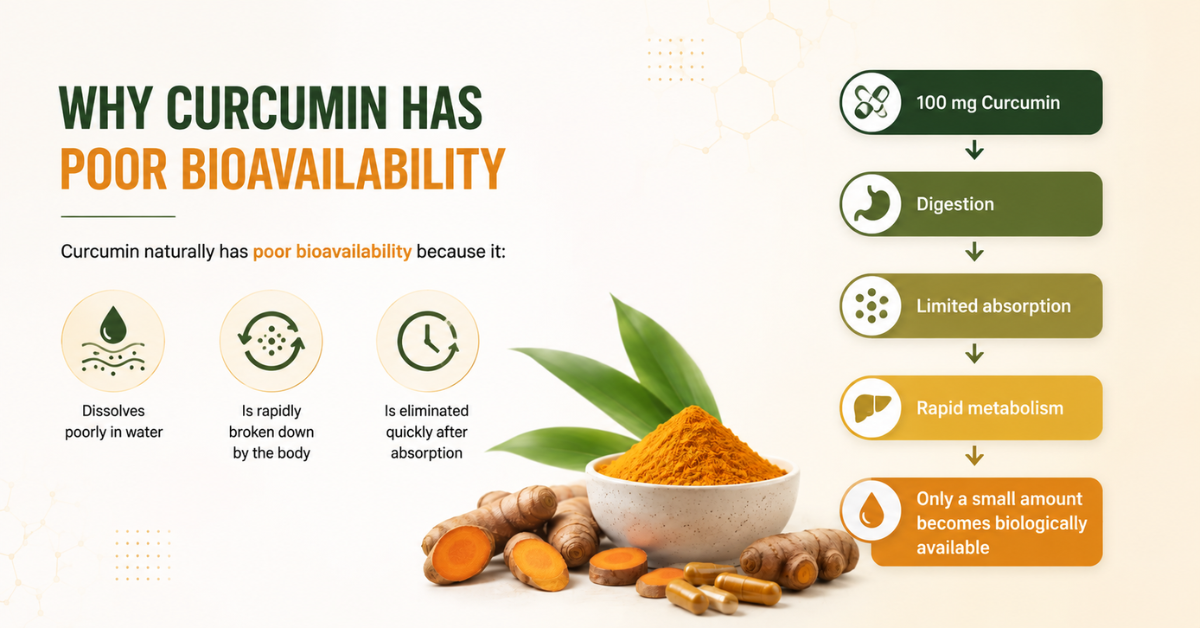
Curcumin naturally has poor bioavailability because it:
- Dissolves poorly in water
- Is rapidly broken down by the body
- Is eliminated quickly after absorption
Imagine taking 100 mg of curcumin.
Only a small fraction may ultimately reach the bloodstream in a form that the body can utilize effectively.
100 mg Curcumin
↓
Digestion
↓
Limited absorption
↓
Rapid metabolism
↓
Only a small amount becomes biologically available
This is why simply increasing the dose doesn’t always solve the problem.
Instead, researchers have focused on improving delivery technologies that help curcumin remain stable, dissolve better, and become more available to the body.
Why Formulation Science Exists
Over the past two decades, scientists have developed various technologies to improve curcumin absorption, including:
- Piperine combinations
- Phospholipid complexes
- Micellar technology
- Liposomal delivery
- Nanotechnology-based formulations
These innovations aim to increase bioavailability without necessarily requiring extremely large doses.
The goal is not just more curcumin, but better-utilized curcumin.
Most Clinical Studies Were Not Done Using Kitchen Turmeric
Many consumers assume that eating turmeric or taking any turmeric capsule is equivalent to the formulations used in published clinical trials.
In reality, there are important differences.
Kitchen Turmeric | Standardized Curcumin |
Culinary spice | Concentrated extract |
Variable curcuminoid content | Standardized active content |
Used in cooking | Used in research studies |
Difficult to compare doses | Consistent dosing |
Most osteoarthritis research has evaluated standardized curcumin formulations rather than ordinary kitchen turmeric.
Numerous clinical studies have reported improvements in joint comfort, physical function, and quality of life when standardized curcumin preparations were used as part of a broader joint management strategy. However, results vary depending on the formulation, dose, study design, and participant characteristics.
This distinction matters because not every product labeled “turmeric” contains the same amount—or quality—of curcuminoids.
Consumer Takeaway
Instead of asking, “Does this contain turmeric?”, ask:
- Is it standardized?
- How much curcuminoid does it provide?
- Has this formulation been clinically studied?
These questions are far more useful when comparing supplements.
Why Modern Curcumin Formulations Are Changing the Story
As scientists recognized curcumin’s absorption challenges, they shifted their attention from the ingredient itself to how it is delivered.
This has led to the evolution of formulation science.
Traditional Curcumin
↓
Curcumin + Piperine
↓
Phospholipid Complexes
↓
Micellar Curcumin
↓
Liposomal Curcumin
Each generation aims to improve one or more aspects of curcumin delivery, including:
- Better solubility
- Improved absorption
- Greater stability
- More consistent availability
- Potentially lower effective doses in some formulations
Among these innovations, micellar curcumin has gained attention because microscopic structures called micelles help disperse curcumin in water, making it easier for the body to absorb.
This illustrates an important shift in nutritional science:
The future of supplementation is not just about the ingredient—it is about the formulation.
An example is CUCIMAX, which uses micellar delivery technology to address curcumin’s naturally poor bioavailability. Rather than simply increasing the quantity of curcumin, such formulations are designed to improve how efficiently the ingredient is delivered. This reflects the broader direction of modern supplement development and should be viewed as an example of formulation science rather than a claim that one product is universally superior.
Why This Matters for Consumers
When comparing curcumin supplements, don’t focus only on the number printed on the label.
A supplement providing better absorption through validated delivery technology may perform differently from one containing a larger amount of conventional curcumin.
In other words, quality of formulation can be just as important as quantity.
Why Gummies, Syrups and Wellness Shots May Not Tell the Whole Story
The supplement industry is constantly evolving, and today’s consumers have more choices than ever. Curcumin is now available as capsules, tablets, gummies, syrups, wellness shots, powders, and ready-to-drink beverages. These formats are convenient and often appeal to people who dislike swallowing capsules or want an easy addition to their daily routine.
However, convenience alone does not guarantee effectiveness.
One of the most important questions consumers should ask is whether the formulation has been scientifically evaluated.
Some newer formats are designed primarily for taste, portability, or consumer appeal rather than maximizing curcumin delivery. While these products may be suitable for general wellness, relatively few have been studied in published clinical trials compared with standardized curcumin formulations.
That does not necessarily mean gummies or wellness shots are ineffective—it simply means the level of supporting evidence may differ depending on the formulation.
How to Compare Curcumin Supplements
Instead of choosing a supplement based on attractive packaging or marketing claims, compare products using evidence-based criteria:
- Is the curcumin standardized?
- Does it use an advanced delivery technology?
- Has the formulation been evaluated in clinical studies?
- Is the manufacturer transparent about ingredient quality?
- Does it clearly state the amount of active curcuminoids?
Choosing supplements based on scientific evidence rather than trends can help consumers make more informed decisions.
Curcumin Alone May Not Solve Joint Pain
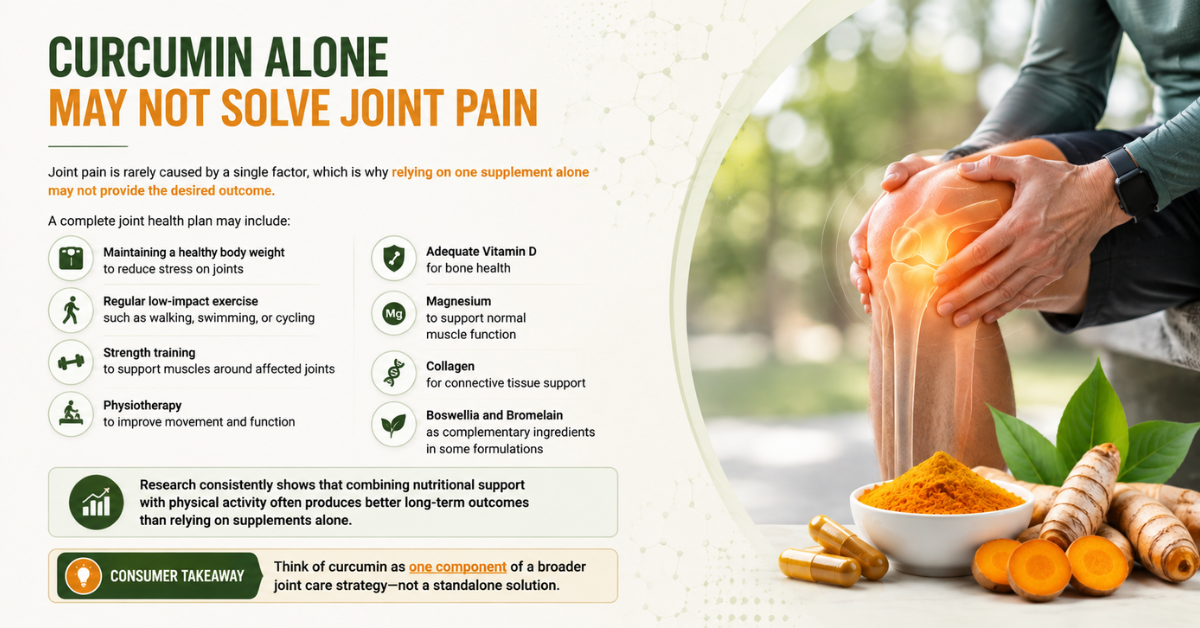
Joint pain is rarely caused by a single factor, which is why relying on one supplement alone may not provide the desired outcome.
Conditions such as osteoarthritis, sports injuries, age-related cartilage changes, or excess body weight require a comprehensive management approach. While curcumin may support a healthy inflammatory response, it is not a replacement for medical care, physiotherapy, or lifestyle modifications when these are needed. Why Isn’t Your Curcumin Working
A complete joint health plan may include:
- Maintaining a healthy body weight to reduce stress on joints
- Regular low-impact exercise such as walking, swimming, or cycling
- Strength training to support muscles around affected joints
- Physiotherapy to improve movement and function
- Adequate Vitamin D for bone health
- Magnesium to support normal muscle function
- Collagen for connective tissue support
- Boswellia and Bromelain as complementary ingredients in some formulations
Research consistently shows that combining nutritional support with physical activity often produces better long-term outcomes than relying on supplements alone and Why Isn’t Your Curcumin Working.
Consumer Takeaway
Think of curcumin as one component of a broader joint care strategy—not a standalone solution.
The Future Is Formulation Science
Nutritional science has evolved considerably over the last decade.
Previously, supplement quality was judged mainly by the ingredient listed on the label. Today, researchers recognize that how an ingredient is delivered can be just as important as the ingredient itself.
Then
Ingredient
↓
Dose
↓
Expected Results
Now
Ingredient
Delivery Technology
Bioavailability
Clinical Evidence
Personalized Nutrition
↓
Better Nutritional Support
This shift explains why modern supplement development increasingly focuses on improving absorption, stability, and consistency rather than simply increasing dosage.
Micellar technologies are one example of this evolution. By improving the dispersion of curcumin in water, these formulations are designed to enhance bioavailability and nutrient delivery. Products such as CUCIMAX represent this newer generation of formulation science, emphasizing evidence-based delivery rather than relying solely on higher curcumin content.
For consumers, the message is clear:
The future of supplementation is about smarter formulations—not just bigger numbers on the label.
The Practical Curcumin Buying Guide
Before purchasing your next curcumin supplement, compare products using these eight important criteria.
Parameter | Why It Matters |
Standardized Curcuminoids | Ensures consistent levels of active compounds. |
Bioavailability Technology | Supports better absorption and utilization. |
Published Clinical Evidence | Indicates that the formulation has been scientifically evaluated. |
Dose Per Serving | Allows meaningful comparison between products. |
Manufacturing Quality | Supports product consistency and reliability. |
Supporting Ingredients | Ingredients such as Boswellia or Bromelain may complement joint health depending on the formulation. |
Duration of Use | Nutritional benefits often require consistent use over several weeks. |
Value Rather Than Price Alone | A scientifically formulated product may offer better overall value than simply choosing the lowest price. |
The best supplement is not necessarily the one with the highest dose—it is the one backed by quality formulation, transparent manufacturing, and scientific evidence.
Consumer Checklist Before Buying Your Next Curcumin Supplement
Before making a purchase, ask yourself these questions:
✔ Is the curcumin standardized?
✔ How many milligrams of active curcuminoids does it provide?
✔ What delivery technology is used?
✔ Does the formulation have published clinical evidence?
✔ Is bioavailability addressed?
✔ How long should I take it before evaluating results?
✔ Does it fit into my overall joint health plan?
✔ Can it be taken alongside my current medications?
If you are taking blood thinners, have gallbladder disease, are pregnant, breastfeeding, or have a chronic medical condition, consult your healthcare professional before starting any curcumin supplement.
Conclusion
Curcumin remains one of the world’s most researched natural ingredients for supporting joint health, but expecting every curcumin supplement to produce the same results can lead to disappointment.
The difference often lies not in the ingredient itself but in how it is formulated, absorbed, dosed, and used as part of a comprehensive joint care plan.
Understanding the distinction between turmeric and standardized curcumin, recognizing the importance of bioavailability, choosing clinically evaluated formulations, and supporting joint health with exercise, weight management, and balanced nutrition can help consumers make more informed choices. Why Isn’t Your Curcumin Working
Modern formulation science—including technologies such as micellar delivery—is reshaping how curcumin supplements are developed. Rather than focusing only on the amount of curcumin listed on the label, today’s consumers should also consider delivery technology, scientific evidence, manufacturing quality, and overall value.
Ultimately, healthier joints depend on more than a single supplement. They require informed decisions, consistent healthy habits, and evidence-based nutritional support.
The next time you shop for a curcumin supplement, don’t just ask “How much curcumin does it contain?”
Instead, ask “How well is this curcumin designed to work?”
That simple question could make all the difference.
AEO (Answer Engine Optimization)
Which curcumin is best?
The best curcumin supplement combines standardized curcuminoids, advanced bioavailability technology, clinical evidence, quality manufacturing, and transparent labeling rather than relying only on a high dose.
Why isn’t turmeric helping my knees?
Kitchen turmeric contains relatively low amounts of curcuminoids compared with standardized extracts used in clinical studies. Joint health also depends on diagnosis, exercise, weight management, and overall treatment.
Which curcumin has the highest bioavailability?
Several advanced formulations—including micellar, liposomal, phospholipid, and nanoparticle technologies—have been developed to improve curcumin bioavailability. Performance depends on the specific formulation and supporting clinical evidence.
Is liposomal curcumin better?
Liposomal curcumin is designed to enhance absorption and nutrient delivery compared with conventional curcumin. Individual results depend on the product formulation and quality.
Is micellar curcumin better?
Micellar curcumin uses microscopic structures that improve water dispersibility and may enhance absorption compared with traditional curcumin extracts.
Can I take curcumin long term?
Many clinical studies have evaluated curcumin over several months. Long-term use should follow product recommendations and your healthcare professional’s advice, particularly if you have underlying medical conditions.
Is curcumin safe with arthritis medicines?
Curcumin may interact with certain medications, including blood thinners. Always consult your healthcare professional before combining supplements with prescription medicines.
Can curcumin reduce inflammation?
Curcumin supports the body’s normal inflammatory response and antioxidant defenses. It should be used as part of a comprehensive health plan rather than as a substitute for prescribed treatment.
Key Takeaways
- Turmeric and curcumin are not the same.
- Standardized curcuminoids provide consistent active content.
- Curcumin naturally has poor bioavailability.
- Formulation influences absorption.
- Clinical studies typically use standardized extracts.
- Micellar technology is designed to improve delivery.
- Higher doses do not always mean better results.
- Look beyond marketing claims.
- Joint pain requires an accurate diagnosis.
- Exercise remains essential for joint health.
- Weight management supports healthier joints.
- Nutrients like Vitamin D and collagen can complement joint care.
- Choose supplements backed by clinical evidence.
- Consistency matters—results may take weeks.
- The best curcumin supplement combines quality ingredients, delivery technology, and scientific evidence.
